

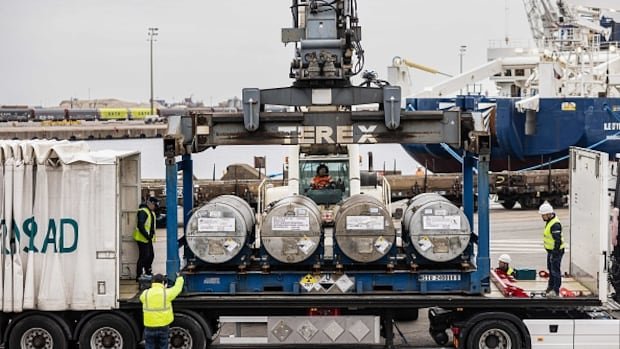

Amidst the Russian military’s occupation of Ukraine’s largest nuclear plant and attacks on the country’s power infrastructure, Europe and the United States continue to rely on Russian nuclear fuel for their electricity grids.
One of the recipients of low enriched uranium (LEU) from Russia for commercial nuclear reactors in the U.S. is Canadian-owned Westinghouse Electric, as per shipping data analyzed by CBC’s investigative program, the fifth estate.
Although the U.S. prohibited the import of Russian enriched uranium in August 2024 to reduce reliance on Russian material and ensure a robust domestic fuel supply, the Prohibiting Russian Uranium Imports Act allows waivers under specific conditions, with the waivers set to expire by January 1, 2028.
The Bellona Environmental Transparency Center in Vilnius, Lithuania, disclosed that in 2025 alone, the U.S. imported 400 tonnes of low enriched uranium from Russia valued at approximately $1 billion US. Major recipients included subsidiaries of French-owned nuclear company Framatome, U.S. nuclear fuel supplier Global Nuclear Fuel Americas, and Westinghouse.
The European Union does not have a ban on importing Russian enriched uranium, and Canada has not imposed sanctions on conducting business with Russia’s state atomic energy corporation Rosatom or its export arm, Tenex.
A nuclear adviser at Bellona emphasized the need for countries to reduce dependence on Russia and terminate all potential cooperation amid ongoing conflicts.
Westinghouse receives enriched uranium shipments from Russia to its South Carolina facility, where the uranium is processed into fuel pellets for commercial nuclear power reactors.
While the U.S. and Europe have long relied on Russian enriched uranium, efforts are underway to bolster domestic production and reduce dependence on Russian supplies.
Westinghouse, a key player in the U.S. nuclear industry, has ties to Canadian companies and has been involved in agreements to support Ukraine’s nuclear energy sector and build new reactors.