

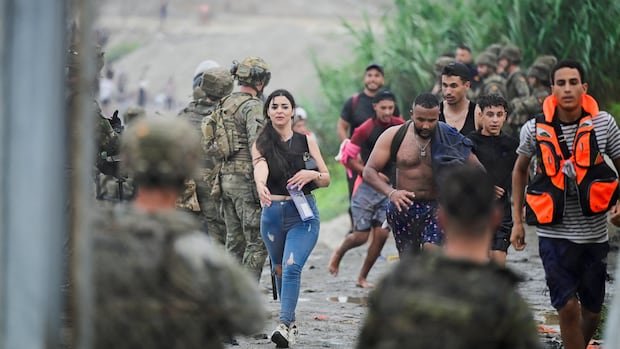

Spain and Morocco bolstered the border barrier of a Spanish enclave on Friday, effectively reducing the influx of migrants after a significant number arrived by sea and land. According to officials, at least 57 individuals have lost their lives, following the entry of around 60,000 people into Ceuta in recent days. By 6 p.m. local time on Friday, an estimated 48,300 migrants had chosen to return to Morocco voluntarily, as reported by Spain’s Interior Ministry.
The sudden surge of migrants into Ceuta, a small Spanish territory extending into the Mediterranean from Morocco, stirred shock and discord in Europe. France announced heightened border checks with Spain, while Italy threatened to suspend Spain from the European Union’s internal open border program. Moroccan authorities at the gates of Ceuta deployed water cannons, pushed back individuals, and used riot control tactics to prevent further border breaches.
Spanish officials affirmed their commitment to swiftly expel those who entered illegally, despite legal constraints imposed by a court ruling on the immediate expulsion of individuals through special border rejection measures. Prime Minister Pedro Sanchez condemned the mass crossings as a violation of Spain’s territorial sovereignty and urged Morocco to intensify efforts to stem the flow of migrants.
Ceuta and Melilla, both Spanish autonomous cities in northern Morocco, serve as the European Union’s sole land borders with Africa. These cities, each housing approximately 85,000 residents, periodically witness surges in migration attempts, but the scale of the recent influx was unprecedented. Territorial Policy Minister Angel Victor Torres suggested that a recent ruling by Spain’s Supreme Court, prohibiting the summary return of migrants intercepted at sea en route to Ceuta or Melilla, may have contributed to the surge.
Migrants typically swim from the Moroccan towns of Fnideq or Belyounech to reach Ceuta, covering distances of around five kilometers or less. Despite increased security on the Moroccan side, groups of migrants sought alternative routes along the coast, with some resorting to swimming as a means of entry. Migration remains a contentious issue across Europe, particularly with the resurgence of right-wing parties since the 2015 migrant crisis.
Concerned nations have ramped up border security measures, with France planning a fivefold increase in police presence at the Spanish border, along with heightened aerial surveillance and train patrols. In response to the situation, Germany, Italy, and Finland expressed support for stricter border controls and potential suspension of Schengen Area agreements with Spain. Meanwhile, in the U.S., President Donald Trump likened the Ceuta crossings to an invasion, emphasizing the need for stronger border enforcement.
While Spain’s government maintains a firm stance on illegal crossings, it emphasizes the economic contributions of immigrants, supported by long-standing data trends. The government’s offer of a mass amnesty program has attracted hundreds of thousands seeking citizenship, despite criticism from some European counterparts regarding immigration policies. Italy’s Foreign Minister and Spain’s Foreign Minister engaged in a diplomatic exchange over the issue, highlighting the divergent views on immigration within the European context.