

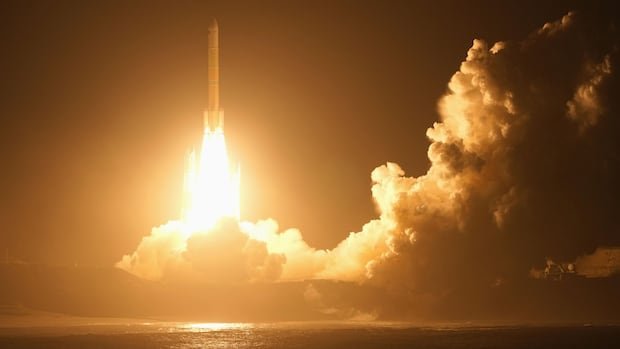

A Japanese spacecraft has been launched towards Mars in an unprecedented mission to explore its enigmatic moons and collect samples. This five-year endeavor, a collaboration between five global space agencies, aims to land a robotic prospector and a rover on Phobos, the larger of Mars’s two small moons.
The Japan Aerospace Exploration Agency spearheaded the ambitious sampling mission, successfully launching the spacecraft from Tanegashima Island’s main spaceport before dawn. The spacecraft separated from the rocket’s upper stage as planned, marking a significant milestone for the mission.
While NASA has a history of successful Mars landings and China recently achieved a touchdown in 2021, no previous mission has ventured to Phobos or its companion moon, Deimos. Moreover, no spacecraft has ever retrieved samples from Mars or its moons, making this mission groundbreaking.
If the mission succeeds, samples comprising dust, soil, and rocks from Phobos are expected to reach Earth by 2031. The project has generated significant excitement among the team members, including NASA astrophysicist Tom Statler, who emphasized the adrenaline and enthusiasm surrounding the endeavor.
Japan’s prior experience with two successful asteroid sample returns positions it favorably for this mission. Dubbed the Martian Moons Exploration (MMX) mission, this $812 million initiative features a substantial five-tonne spacecraft scheduled to reach Mars by late summer. The spacecraft will rendezvous with Phobos, deploying the French-German rover named Idefix, designed to land on Phobos’ surface.
Idefix, comparable in size to a microwave oven, is engineered to self-right if it lands upside down. As it explores Phobos for 100 days, the rover will assess terrain safety for the subsequent landing of a four-legged stationary lander to collect samples in late 2028 or 2029.
After a brief two-hour visit to Phobos, the lander will extract at least 10 grams of material before studying Deimos during flybys. The spacecraft is set to return to Earth in 2031 for a sample delivery in the Australian desert, marking the culmination of this intricate and ambitious mission.
The scientific community anticipates crucial insights into the formation of Mars’s moons, Phobos and Deimos, shedding light on their origin through potential collisions or gravitational capture. These findings are expected to deepen our understanding of planetary and moon formation processes, offering valuable insights for future Mars exploration missions.
Japan’s investment of $350 million in this mission, along with contributions from NASA, the French Space Agency, the German Space Agency, and the European Space Agency, underscores the collaborative and multi-faceted nature of this groundbreaking venture.