

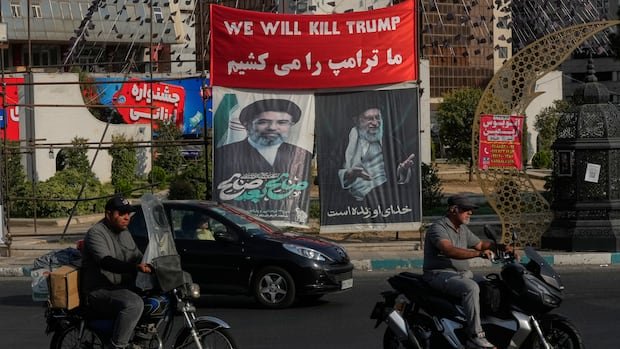

A senior adviser to Iran’s Islamic Revolutionary Guard Corps (IRGC) has stated that Iranian officials have observed the perceived weakness of the American military since the United States and Israel initiated their attack on Iran earlier this year. Talks to resolve the conflict have hit a standstill.
In a rare interview with Western media, Brig.-Gen. Mohammad Reza Naqdi, the supreme adviser to the IRGC’s commander-in-chief, shared with PBS News Hour that Iran has not achieved its final goal in the ongoing war.
Naqdi expressed confidence in Iran’s current position, stating, “We are currently victorious, and we will continue to be victorious in the future.” The interim agreement between the U.S. and Iran, intended to halt the hostilities, is due to expire soon.
Recent comments from Naqdi come after the breakdown of a ceasefire, prompting a series of strikes between the U.S. and Iran over a two-week period before a temporary halt. Naqdi highlighted the importance of gaining experience through the prolonged conflict, emphasizing that Iran has learned how to engage with the American military effectively.
On a separate note, U.S. President Donald Trump reaffirmed the United States’ control over the Strait of Hormuz, describing it as impenetrable. Trump’s statement comes amidst a fluctuating stance on escalating tensions and prospects for peace negotiations.
In parallel efforts, Pakistan is actively engaged in facilitating peace talks between Iran and the U.S. Pakistani officials have been meeting with Iranian counterparts to explore avenues for resuming negotiations. The discussions have centered around Iran’s control over the vital shipping route of the Strait of Hormuz, a critical point of contention in the conflict.
As the conflict persists, both Iran and the U.S. have intensified their rhetoric, with Iran’s top security official, Mohsen Rezaei, asserting that the Strait of Hormuz will remain closed unless the U.S. meets Iran’s stipulated conditions for ending the war. Meanwhile, Trump has demanded compensation from Iran for various historical conflicts and incidents.
The ongoing war in the Persian Gulf has resulted in significant casualties and disruptions across the region, with both sides engaging in military actions in multiple countries. Efforts to reach a final agreement on Tehran’s nuclear program and the lifting of U.S. sanctions remain unresolved as the deadline looms.
These developments underscore the complexity and challenges faced in achieving a lasting resolution to the conflict between Iran and the United States.