

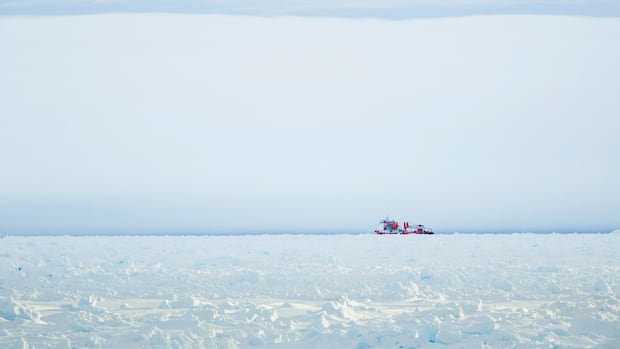

Canada and the United States have been covertly monitoring two Chinese icebreaker research vessels in the Arctic waters near Alaska for the past few weeks. The Xue Long (Snow Dragon) and Xue Long 2 ships navigated north through the U.S. exclusive economic zone in the Bering Sea in July, as reported by the U.S. Coast Guard.
The presence of Chinese research vessels in the Arctic Ocean during recent summers has raised concerns among security and defense officials. Data from independent research consultant and ship tracker Steffan Watkins revealed that a Royal Canadian Air Force CP-140 surveillance plane has been operational in Alaska since early July.
The Canadian Department of National Defence confirmed that they are actively observing the activities of the two Chinese vessels in coordination with the United States. The vessels are currently outside of Canada’s exclusive economic zone, an area beyond territorial waters where the country holds sovereign rights over resources and jurisdiction over activities like research and marine environment protection.
In response to inquiries about the Chinese ships, Defence Minister David McGuinty stated that Canada actively monitors its waters. China, considering itself a near-Arctic state, maintains that its icebreakers’ deployment is solely for peaceful scientific research, environmental monitoring, and climate change studies. However, these research ships have been known to deploy advanced sonar and telemetry buoys, which Western defense officials believe can track environmental changes, undersea topography, and submarine activities.
The Canadian military initiated Operation Latitude last year to enhance monitoring of northern waters and collaborate with Pacific allies, particularly in the Bering Sea off Alaska. The Royal Canadian Navy has committed the frigate HMCS Ottawa, Arctic offshore ships HMCS Max Bernays and HMCS Robert Hampton Gray, along with the air force’s surveillance aircraft. Canadian Special Operations Forces Command members and the icebreaker CCGS Des Groseilliers are also participating in the operation.
As Canada plays a more significant role in the western Pacific amidst the U.S. Navy’s engagements, concerns arise about the aging fleet’s capabilities. The Canadian navy’s frigates and coast guard ships, part of the essential Halifax-class vessels, are between 30 and 40 years old. The House of Commons defense committee members traveled to the Arctic in July, emphasizing the need for increased surveillance and response capabilities to address incursions in the region.
In response to growing foreign interests in the Arctic, the Canadian government is investing in new destroyers, acquiring Arctic-capable submarines, and deploying an undersea sensor network. The urgency stems from the need to safeguard sovereignty, especially in areas like the Northwest Passage, where Russia and China contest maritime claims. With considerable energy resources at stake in the Arctic, Canada aims to enhance defense measures against potential adversaries.