

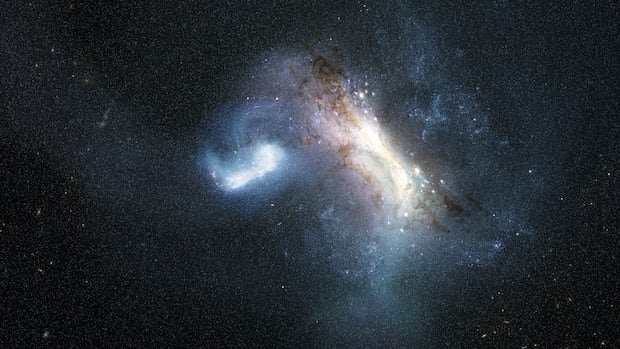

The vast and spiral-shaped Milky Way galaxy, housing billions of stars including our sun, underwent a complex journey to reach its current size, according to recent research detailing a significant event early in its past.
Researchers studying star clusters near the Milky Way’s core have found evidence indicating that our galaxy engulfed a smaller galaxy around 11.8 billion years ago, when the universe was young. This marks the earliest-known galactic merger involving the Milky Way, demonstrating its growth through both internal star formation and mergers with smaller galaxies drawn into its gravitational field.
The smaller galaxy, classified as a dwarf galaxy, was estimated to contain stars equivalent to 500 million solar masses at the time of the merger, making it a quarter the size of the Milky Way back then. Utilizing data from the Hubble and Gaia telescopes, scientists analyzed stellar clusters within the innermost 20,000 light-years of the Milky Way, examining their age, chemical makeup, and trajectories to piece together this historical merger event.
These stars became integrated into the Milky Way following the merger, which occurred roughly two billion years after the universe’s inception during the Big Bang. The dwarf galaxy involved in this event was dubbed Low-energy-Kraken-Heracles (LKH) in reference to previous studies exploring the likelihood of such a galactic fusion.
Lead author Davide Massari, an astrophysicist from the National Institute for Astrophysics in Bologna, Italy, highlighted the study’s key discovery of the Milky Way’s first merger experience in its early stages. The findings shed light on the debate surrounding whether the Milky Way’s initial growth stemmed from internal star formation or galactic interactions, indicating that the merger introduced a considerable number of stars, interstellar gas, and dark matter into the Milky Way, fueling subsequent star formation.
Massari noted that while the merger appeared peaceful in terms of star interactions, the collision of gas from the two galaxies likely triggered intense star formation. The Milky Way has also been involved in two other major galactic mergers, further shaping its evolution and influencing the formation of celestial bodies within it.
Understanding the Milky Way’s past through mergers contributes to answering fundamental questions about the origins of our solar system and Earth, highlighting the significance of reconstructing the galaxy’s history.