

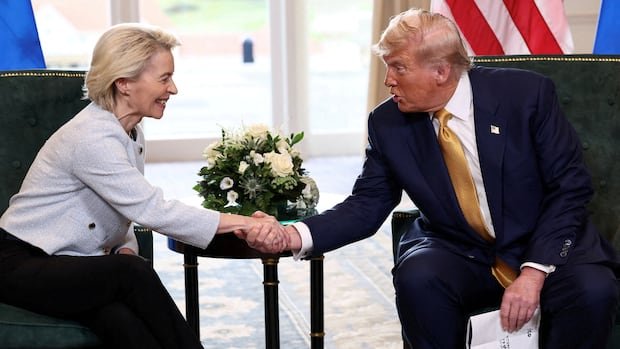

European Union Commission President Ursula von der Leyen’s visit to Donald Trump’s Turnberry golf resort in Scotland last year resulted in a pledge to European citizens that accepting a 15 per cent U.S. tariff on EU exports would bring “predictability and stability.” However, some critics now view this trade agreement as a unilateral surrender that has led to ongoing American economic pressure tactics.
The initial dispute arose when the U.S. sought to reclassify certain European industrial goods to apply higher tariffs. Subsequently, a new conflict emerged over European plans to impose a digital services tax on U.S. tech giants, mirroring Washington’s recent efforts to dictate tax policies to Ottawa.
Shortly after the European Parliament ratified the Turnberry deal, Trump took to social media platform Truth Social, threatening to impose 100 per cent tariffs on any European nation implementing or expanding tech taxes. In response, European lawmakers are considering Mark Carney’s departure from U.S. trade negotiations as a model for standing up to aggressive demands.
Former French ambassador to the U.S., Gerard Araud, suggested that Canada’s approach of firmness with Trump should inspire the EU to resist coercion. German parliamentarian Bernd Lange emphasized the importance of democratic nations working together against such tactics.
While public support for Carney’s stance remains discreet, many European leaders privately admire Canada’s strategy in the trade dispute. The EU’s reluctance to confront Trump on trade issues contrasts with its strong response to territorial disputes, such as Trump’s bid to acquire Greenland.
The trade deal pursued by Britain with Trump has fallen short of expectations, with British exporters facing tariffs and losing competitiveness. The U.K.’s willingness to reconsider its digital services tax under U.S. pressure highlights the challenges of negotiating with the current administration.
Trade experts caution that replicating Canada’s resistance may be difficult due to public sentiment and economic interdependence. The long-term impact of failed negotiations with the U.S. remains a concern for European allies, given the shifting reliability of the current administration.
Despite setbacks, the possibility of revisiting trade negotiations remains open, as history shows that failed deals can be revived. The declining global confidence in Trump’s leadership underscores the need for Europe, the U.K., and Canada to navigate these challenges strategically.