

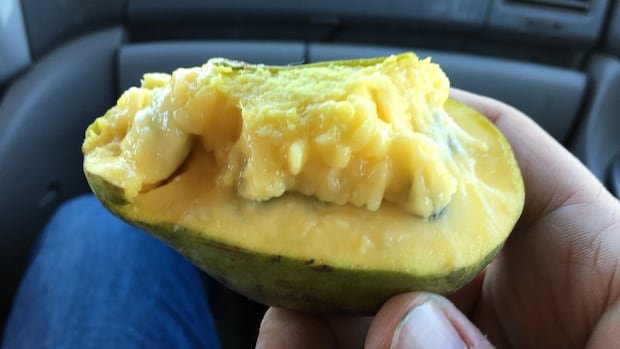


It may come as a surprise to know that the exotic-tasting pawpaw fruit thrives in Canada. Chef Tawnya Brant raves about the delight of indulging in one if you manage to acquire it.
Brant, the proprietor of Yawékon Foods and the host of APTN’s One Dish One Spoon, likened the flavor of pawpaw to a blend of banana, mango, and pineapple, with a velvety consistency that transforms into a caramel-like sweetness as it ripens.
Describing the pawpaw fruit as a peculiar version of a banana, she highlighted its unique oval shape and large seeds within.
Pawpaws have thrived in North America for centuries, once plentiful from Florida to Missouri and southern Ontario. Indigenous communities predominantly cultivated them before being displaced due to land clearing. Despite their limited availability, some pawpaw trees still grow in the wild and are found in orchards across southern Ontario, British Columbia, and Quebec, yielding fruits in autumn.
The reason behind pawpaws remaining relatively obscure is their short shelf life and susceptibility to browning and bruising post-harvest, making commercial harvesting and distribution challenging.

Exploring wild pawpaws in a clandestine location near London, Ontario, with forager and ecologist Mathis Natvik.
Brant’s initial encounter with pawpaws occurred roughly ten years ago when a friend brought some to her late mother’s garden. She shared that the Haudenosaunee had facilitated the transportation of pawpaw trees up the eastern coast over the centuries due to their fondness for the fruit.
Thomas Mathias ventured into pawpaw cultivation on his farm approximately 15 years ago. He experimented extensively to achieve a successful harvest, emphasizing the use of llama and horse manure to attract pollinating blue bottle flies.