

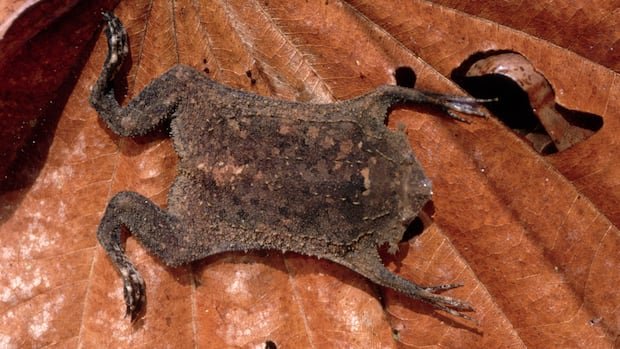

In a recent discovery, researchers in California have revealed a fascinating ability of the Surinam toad, known for its peculiar characteristics. Despite its flat body, limited vision, and lack of a tongue, this toad has been found to possess a unique sensory mechanism: it can effectively detect and capture prey using its fingertips.
For centuries, scientists have marveled at how this toad, with its unconventional features, manages to be a proficient hunter in the murky waters of the Amazon basin. With its small eyes and challenging visibility in its environment, the Surinam toad swiftly captures fish by swiftly sucking them into its mouth in a fraction of a second.
The recent study conducted by Duncan Leitch and his team at the University of California, Los Angeles, sheds light on this phenomenon. Referred to as the star-fingered toad, this amphibian employs its fingertips to sense subtle water movements caused by nearby prey. The fingertips, equipped with intricate touch organs resembling the human eye’s fovea, can discern the size and proximity of potential prey through signals processed by neurons.
Remarkably, the Surinam toad can draw prey into its mouth without direct contact, even in darkness, by leveraging its highly sensitive fingertips. Each toad possesses 128 tiny lobes on its fingertips, covered with papillae that enhance touch sensitivity, similar to those found on the human tongue.
This discovery is significant as it challenges the notion that such complex sensory strategies are exclusive to mammals with more advanced brains. The study suggests that despite millions of years of separate evolution, frogs and mammals have converged on a similar solution to amplify sensory information from specific body areas. Understanding these evolutionary adaptations in lower vertebrates like amphibians offers valuable insights into the development of sensory systems in vertebrates.