

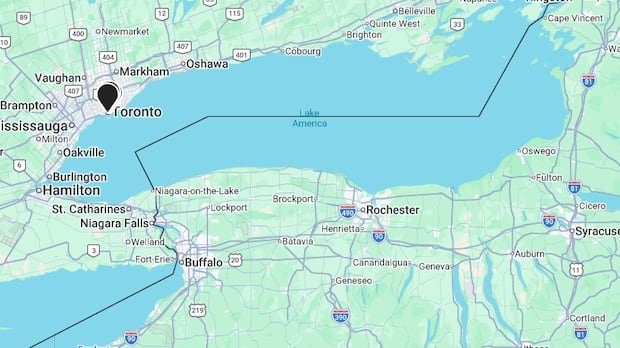

Numerous Canadian websites, including those for the federal government, exhibited maps depicting Lake Ontario as “Lake America” following Google Maps’ adjustment to comply with a directive from U.S. President Donald Trump. Google indicated that it updated the name due to a formal change in the U.S. government’s geographic names database.
Although Google stated that the alteration would impact only U.S. users, several Ontario and Canadian web platforms displayed Lake America on their maps. Entities such as Hydro One, the Liquor Control Board of Ontario (LCBO), GO Transit, and the federal government showcased the renamed lake on their maps.
Hydro One acknowledged the error, attributing it to a third-party mapping service. The utility confirmed efforts to rectify the issue promptly. Metrolinx, the agency overseeing GO Transit, also acknowledged the matter and pledged to ensure the accurate naming of Lake Ontario on their websites.
Meanwhile, MapQuest affirmed its decision not to modify the lake’s name, and Apple has remained silent on the issue. Google clarified that developers embedding Google Maps can localize the map by selecting the region, ensuring proper place names display on their sites.
Tech expert Carmi Levy explained that Canadian websites, including those of Hydro One and LCBO, likely utilize Google’s application programming interface (API) for their maps. Levy emphasized that APIs lack location awareness, causing maps to default to “Lake America.”
Levy recommended developers select Canada as their region to localize maps, a relatively straightforward solution. However, he highlighted that until all developers adopt this practice, discrepancies in map labeling may persist.
Notably, Google Maps tailors results based on a user’s location, ensuring Canadians see “Lake Ontario” despite typing “Lake America.” The search index update allows global access to the “Lake America” name, with searches outside North America displaying both names.
The situation underscores Canada’s digital dependence on American companies due to the absence of homegrown mapping solutions. Ontario’s Minister of Public and Business Service Delivery and Procurement acknowledged the issue and pledged website reviews for accurate lake identification.
Ontario Premier Doug Ford criticized Trump’s name change proposal for Lake Ontario, asserting the lake’s historical identity. Ford unveiled a sign in Winona reinforcing the lake’s name, emphasizing its permanence.
In response to the escalating trade tensions between Canada and the U.S., both countries have exchanged accusations regarding trade deal changes. The federal government announced retaliatory measures against new U.S. tariffs, slated to come into effect in September.
Ford softened his stance on the trade war during an American TV appearance, advocating for a return to constructive trade discussions. Trump’s executive order mirrors a previous change to the Gulf of Mexico’s name to the Gulf of America, sparking similar online confusion.
Levy drew parallels between the Gulf of Mexico renaming and the current Lake Ontario situation, highlighting the complexities of such changes in digital systems.