

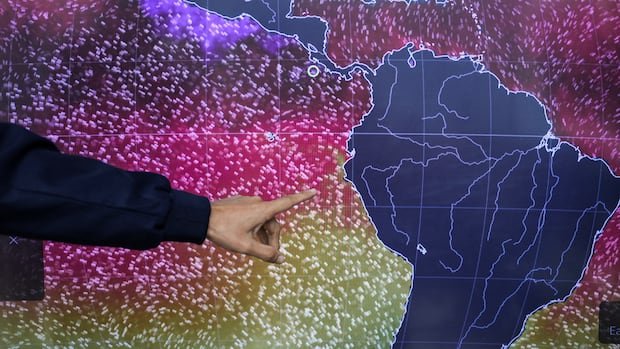

El El Niño phenomenon, known for causing natural climate fluctuations and elevating global temperatures periodically, is expected to reach its peak in several months and persist through the upcoming spring, as per experts’ forecasts.
Currently, noticeable impacts of El Niño are already evident in both weather patterns and human readiness. Here is a visual overview showcasing how El Niño is actively leaving its imprint.
### Reduced Water Levels in Panama Canal
A ship sails through the Panama Canal near a hydrometeorological monitoring station on August 27, with diminished rainfall due to El Niño affecting water levels in Gamboa, Panama.
*(Image: A man stands near a large pillar structure in water, indicating a significant drop in water levels. In the background, a ship traverses the water.)*
The Panama Canal Authority hydrologist, Ricardo Guete, highlights the low water level on a gauge at the monitoring station in Gatun Lake. The authority plans to restrict daily transits in early September as a precaution for the prolonged El Niño season.
### Displaced Seabirds
Blue-footed boobies gather on rocks near the entrance of the Panama Canal on August 5. Increasing numbers of seabirds are seen near Panama City as El Niño warms the eastern Pacific, disrupting marine food supplies.
*(Image: Six birds perched on a rock.)*
### Preparedness Measures Across Latin America
Governments throughout Latin America are mobilizing firefighting efforts, activating contingency plans, and fortifying water, energy, and transportation systems in anticipation of the strengthening El Niño phenomenon across the Pacific. Concerns arise regarding potential droughts, extreme heat waves, flooding, and other climate-related disturbances in the upcoming months.
In Honduras, the Secretariat of Risk Management and National Contingencies issued a red alert in 75 municipalities in central and southern regions, along with a yellow alert in 71 other municipalities due to adverse climate conditions affecting agriculture and livestock. A cornfield impacted by drought is observed as police officers ride past on a motorcycle on August 26.
*(Image: Two people in police uniforms on a small motorcycle with a dry cornfield in the background.)*
Unlike sudden disasters like hurricanes or earthquakes, El Niño develops gradually over months, providing governments with the opportunity to prepare for its severe implications. In Peru, President Keiko Fujimori has prioritized readiness for El Niño, as depicted in her collaboration with Lima Mayor Renzo Reggiardo in a preventive operation on the Rímac River.
### Indonesia Facing Intense Heat
In Indonesia, salt farmers in West Java province are benefiting from an El Niño-induced drought, while crop farmers brace for prolonged challenges stemming from the scorching heat.
*(Image: A man beside rows of large blue bags on a small water body.)*
Indonesia’s Meteorology, Climatology, and Geophysics Agency (BMKG) anticipates an intensified and extended dry season for most of the country, partly attributed to El Niño. Villagers in Gunung Batur collect spring water in bottles due to difficulties in accessing groundwater at their residences, emphasizing the intensified dry conditions influenced by El Niño.
*(Image: Four people surrounded by numerous large plastic water bottles.)*
### Global Impact and Warnings
A strengthening El Niño has broken intensity records in its initial stages, likely leading to more extreme weather events worldwide, as cautioned by United Nations officials. While not directly causing Indonesia’s wildfire crisis, El Niño exacerbates the situation by creating hot and dry conditions, enabling rapid fire spread. Firefighters commemorate Indonesia’s 81st Independence Day amidst the challenges posed by forest and land fires in Palangkaraya on August 17.
*(Image: Nine individuals salute the national flag in a smoldering landscape.)*
On the other side of the globe, Canada anticipates a warmer winter due to the potent El Niño, with regions like British Columbia’s south coast expecting reduced precipitation and snowpack levels. El Niño typically results in fewer tropical storms in the Atlantic.
For insights into how El Niño might impact Canada, refer to this video:
[WATCH | What Canadians can expect from a very strong El Niño](https://voiceofmoscow.com/wp-content/uploads/2026/10/default-812.jpeg)
*Some climate models predict a robust El Niño year in 2026, potentially bringing significant impacts. CBC’s Nick Logan delves into what this means and what Canadians can anticipate.*
**Source:** [Original Article](https://www.cbc.ca/news/world/el-nino-effects-drought-storm-surge-weather-9.7326585)