

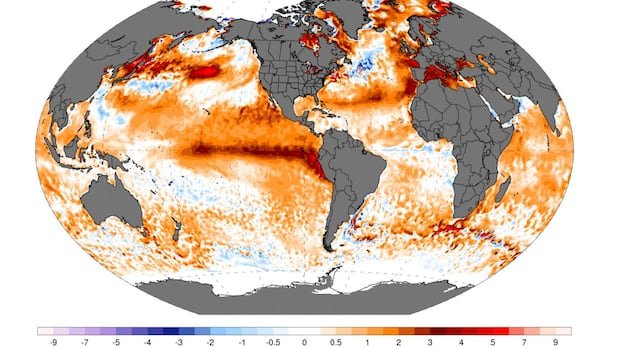

The highly anticipated El Niño has arrived, and it is already proving to be significant. Earlier this year, climate experts predicted the development of an El Niño in the central Pacific region. Over time, more models started indicating a potentially strong or “super” El Niño, although it was cautioned that certainty was premature.
In June, the U.S. National Oceanic and Atmospheric Administration (NOAA) confirmed the presence of warmer conditions in the specific Niño 3.4 region of the Pacific Ocean in their monthly update. To qualify as an El Niño, temperatures in this area must be at least 0.5 degrees Celsius above average. Currently, ocean temperatures are nearly 2 degrees Celsius above average, setting a record high for this time of year.
Zeke Hausfather, a climate scientist from Berkeley Earth, noted that temperatures in the traditional Nino 3.4 region have surpassed 2 degrees Celsius, indicating strong El Niño conditions even in early July. El Niño and La Niña are part of the broader El Niño Southern Oscillation cycle, with La Niña bringing cooler temperatures and El Niño bringing warmer conditions.
Experts suggest that the El Niño peak may occur in October, although most models lean towards November or December. The potential intensity of this El Niño has raised concerns, with some projections hinting at unprecedented temperature anomalies. The abrupt transition from La Niña to El Niño within a year has puzzled meteorologists like Nat Johnson from NOAA.
The looming El Niño raises questions about its connection to climate change, with varying opinions on the subject. As the situation unfolds, uncertainties persist regarding the impacts, especially on food security in tropical regions and potential wildfire risks in Western Canada. The severity of this El Niño underscores the need for preparedness and vigilance across various sectors.
The forthcoming months will be crucial in monitoring the evolution of this El Niño event and its implications on global climates and ecosystems.