

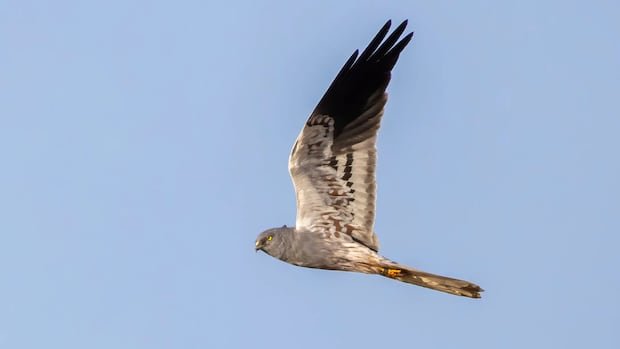

Conservationist Mark Thomas recently highlighted the crucial role played by a remarkably successful male bird in preserving a rare species in the United Kingdom. Known as AU, the male Montagu’s harrier has fathered a total of 16 offspring, with 10 born in the past two years alone, significantly contributing to the species’ survival in the UK, according to Thomas, who leads the Royal Society for the Protection of Birds (RSPB) for this species.
Montagu’s harriers are migratory birds of prey that breed in Europe after spending their winters in Africa and parts of Asia. Despite being globally classified as a species of least concern, their population is declining. In the UK, these birds have faced a rapid decline, nearly vanishing from the country. From a peak of around 30 breeding pairs in the 1950s to zero in the ’70s, efforts to protect them have seen some progress, including a recent increase to 13 pairs in the mid-2000s, followed by another decline and subsequent recovery.
The standout performance by AU has been pivotal in the recent success of the species, with the male’s acrobatic mating displays impressing and attracting multiple females. This year, AU successfully mated with two females, resulting in six chicks, reinforcing hopes for the species’ future in the UK. Conservationists have taken extra measures to safeguard the nests of these new hatchlings, ensuring their protection from predators and other dangers.
The RSPB has taken a significant step by attaching satellite trackers to two juvenile Montagu’s harriers, a first for the organization. This initiative aims to monitor the birds’ migration patterns, providing valuable data that could aid future conservation efforts. Thomas and his team are eagerly awaiting the insights these trackers will offer, potentially shedding light on the birds’ movements and breeding habits, ultimately aiding in the ongoing conservation of this unique species.