

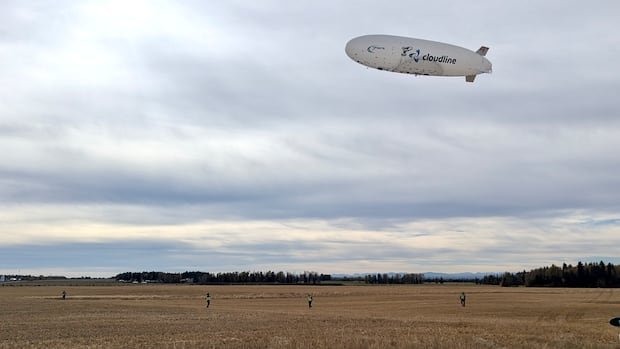

Last week, central Alberta witnessed an unusual spectacle in the sky that caught the attention of many onlookers: a 20-meter airship. While the sight of a Goodyear Blimp may be familiar at sporting events, it’s not a common occurrence in rural Alberta.
The airship in question was a solar-powered aircraft, about the size of a school bus, conducting aerial survey tests near Rocky Mountain House, approximately 200 kilometers southwest of Edmonton. A collaboration between Cloudline, a South African aerospace company that manufactured the airship, and its Canadian partner, 3 Points in Space Media, carried out flight trials at the Rocky Mountain House Airport.
3 Points in Space Media’s founder and CEO, Sean Adams, likened the airship to a helium party balloon and highlighted its innovative technology, which integrates control systems to operate as an autonomous airship. The crew partnered with TC Energy to assess pipeline corridors in the region using this cutting-edge technology.
Pre-flight preparations involved filling the airship’s envelope with helium and undergoing diagnostic checks while tethered. Once cleared, the airship was released for calibration runs before embarking on extended survey flights, covering distances of up to 100 kilometers.
Cloudline’s CEO, Spencer Horne, emphasized the airship’s significant payload capacity of 40 kilograms, enabling it to carry heavier camera and LiDAR sensors over much longer distances compared to standard drones. Despite its capabilities, Adams acknowledged that crewed aircraft are still preferred for extreme weather conditions.
TC Energy’s vice-president of pipeline integrity, Joe Zhou, commended the initiative for its ability to gather diverse data types in a single flight and noted the quieter operation of the airship compared to traditional aircraft.
The operation of the airship by 3 Points in Space Media represents a modern revival of historic aviation technology. Michael Adams, the company’s vice-president of research and development, sees this as an opportunity to modernize airship technology that waned in popularity after the Hindenburg disaster in the 1930s.
Local residents in Rocky Mountain House marveled at the rare sight of the airship, creating a buzz in the community. The next phase for the flight team involves cold-weather testing in northern Ontario to ensure the airship’s readiness for sub-zero and Arctic conditions.
As Cloudline expands its operations globally, with airships in countries like South Africa, Namibia, and Kenya, the presence of autonomous airships in Canadian airspace remains a novelty. The successful integration of past aviation heritage with modern technology underscores the promising future of airship technology.