

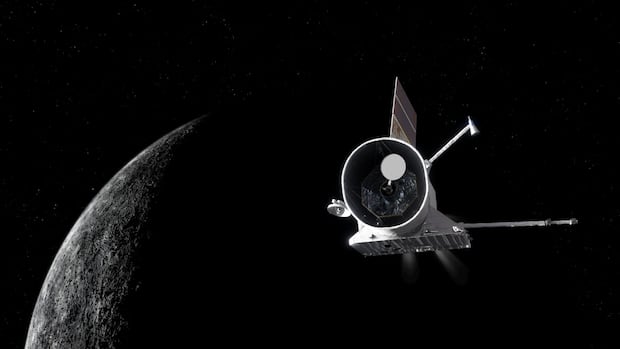

On Monday, the European Space Agency announced that the BepiColombo mission, a collaborative effort between Europe and Japan to investigate Mercury, remains “on track” and that the spacecraft is secure, despite experiencing a minor hiccup when it first entered orbit around the solar system’s innermost planet.
ESA confirmed on Saturday that BepiColombo successfully entered orbit around Mercury following an eight-year journey from Earth, but revealed on Sunday that the thrusters used for the spacecraft’s positioning fired for a shorter duration than intended.
In a statement released on Monday, the space agency reassured that “BepiColombo is safe and in a stable orbit around Mercury.”
The robotic vehicle comprises ESA’s Mercury Planetary Orbiter and the Japan Aerospace Exploration Agency’s Mercury Magnetospheric Orbiter, each with distinct scientific missions and set to separate in the upcoming weeks.
ESA’s Monday statement indicated that the mission is “on track for the separation of its two science orbiters” scheduled for December 9, as was planned.
The agency noted that teams at the European Space Operations Centre collaborated with lead spacecraft manufacturer Airbus and other partners to address the thruster malfunction, which “has been traced to a software glitch.”
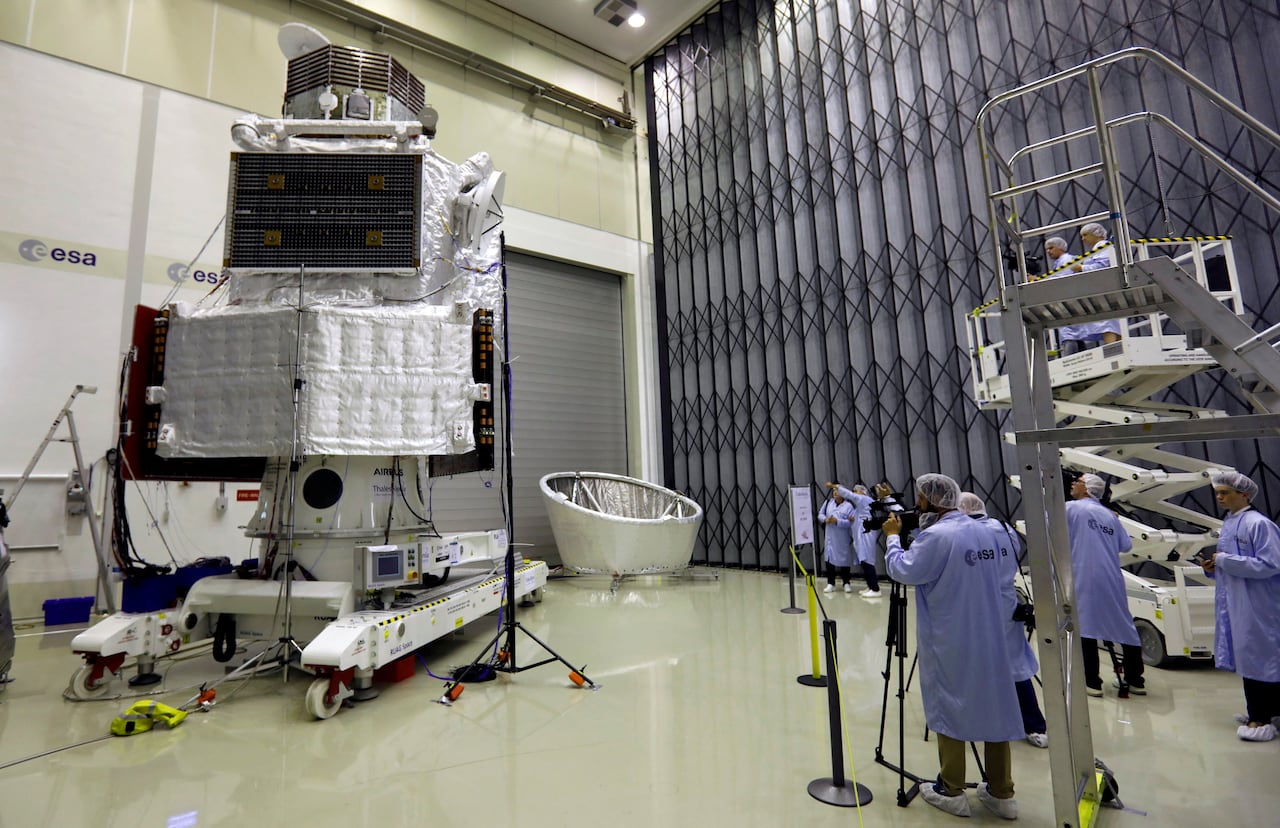
The BepiColombo spacecraft is shown at the European Space Agency’s European Space Research and Technology Centre in Noordwijk, Netherlands, in July 2017. (Michael Kooren/Reuters)
According to ESA, as BepiColombo flew 635 kilometers above Mercury’s surface, its thrusters began firing as expected.
This burn was anticipated to last for 37 minutes, slowing the spacecraft sufficiently to establish its orbit; however, the maneuver was “autonomously interrupted, and the spacecraft entered safe mode—a protective state designed to maintain the spacecraft’s safety by halting all non-essential activities when it encounters unexpected situations,” ESA explained.
-
The new milestone Voyager 1 just crossed in interstellar space
-
SpaceX Starship successfully re-docks at Texas launch pad after orbiting Earth
ESA reported that mission control assessed that, since the burn concluded early, the spacecraft achieved approximately 77 percent of the overall planned velocity change. The agency stated that additional thruster burns are scheduled for the coming months to adjust BepiColombo’s orbit.
Routine scientific operations are expected to begin in April, according to ESA.
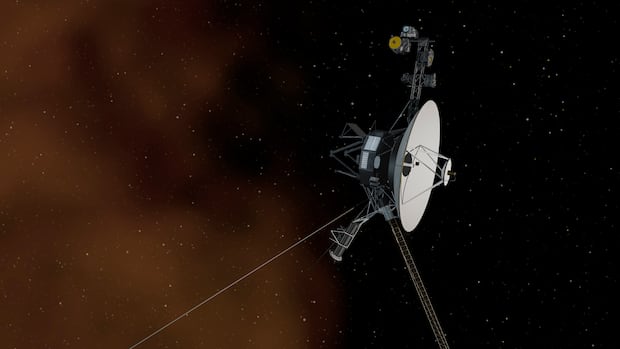
It took 49 years for the Voyager 1 spacecraft to travel 25.9 billion kilometres from Earth, the farthest point for any human-made object. It’s now so far away that it takes light — and radio signals — a full day to reach it from Earth.
The mission control team is based in Darmstadt, Germany.
Mercury, slightly larger than Earth’s moon, is the least explored of the four inner solar system planets, with BepiColombo being only the third spacecraft to visit and the second to orbit the planet.
This mission aims to uncover mysteries about Mercury, including the reasons behind its magnetic field, the presence of ice in its polar craters, and the nature of the intriguing depressions known as “hollows” on its surface.
Launched in 2018, BepiColombo is set to enhance our understanding of this enigmatic planet.