

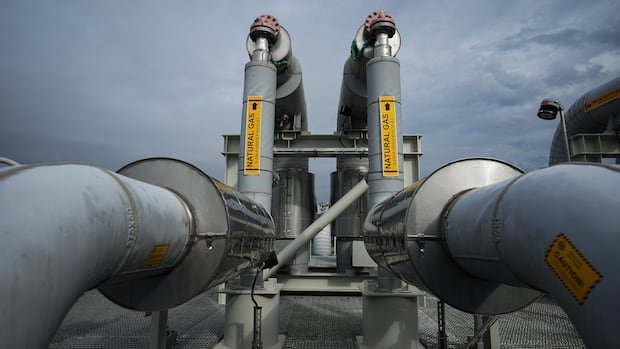

Prime Minister Mark Carney recently highlighted the significant role Canada plays in fueling American economic growth through exports of natural gas. This raises the question of what would happen if Canada were to cease sending these energy products south of the border.
Despite the ongoing trade tensions between Canada and the U.S., energy resources such as oil and natural gas have not been used as bargaining tools. While Alberta Premier Danielle Smith has consistently opposed this idea, Ontario’s Doug Ford believes all options should be considered.
In a recent speech following stalled trade talks between Canada and the U.S., Carney emphasized the importance of Canadian energy exports to the U.S. He pointed out that Canada supplies 99% of the U.S.’s natural gas imports, 85% of electricity imports, and 60% of crude oil imports.
Although the U.S. heavily relies on Canadian natural gas imports, the actual percentage of U.S. natural gas consumption from Canada is relatively low, around eight percent according to the U.S. Energy Information Administration (EIA).
Dulles Wang, director of Americas gas and LNG at Wood Mackenzie, noted that the percentage of Canadian natural gas in the U.S. market is even lower than estimated by the EIA, at around five percent. Gas pipelines crisscross the Canada-U.S. border, facilitating the flow of natural gas for various purposes including heating, electricity generation, and industrial use.
Enbridge, based in Calgary, stands as the largest natural gas provider in North America. The company recently completed significant deals to acquire three U.S. utilities, solidifying its position in the energy market.
While Canada’s natural gas shipments to the U.S. may seem modest compared to domestic production, the geographical distribution of these deliveries is crucial. For instance, Canadian gas plays a vital role in supplying regions like the Pacific Northwest, where a significant portion of gas comes from Canada.
The potential impact of halting natural gas exports to the U.S. could be detrimental for the Canadian energy industry, leading to a surplus of supply and plummeting prices. Wang emphasized that such a move would not benefit either country and stressed the importance of diversifying energy markets beyond the U.S.
Efforts are underway to expand Canada’s energy exports, with initiatives like the LNG Canada project targeting Asian markets. The government’s support for these projects reflects a strategic shift towards reducing dependence on the U.S. market and enhancing energy trade globally.