

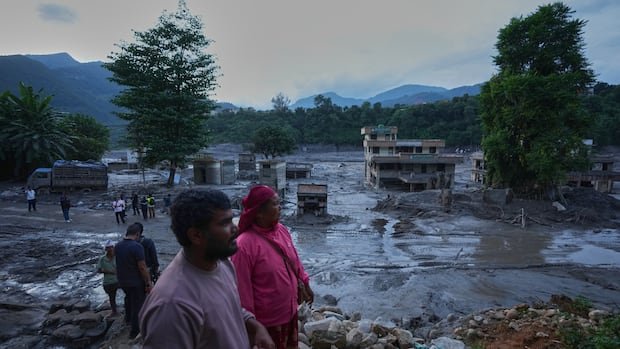

Geoscientist Jakob Steiner describes the recent glacier incident in Nepal’s Himalayas as resembling a massive chunk being sliced off and plummeting down the mountain cliff. The devastation, which involved ice, rock, and sediment cascading 1.2 km from a 5,000-meter altitude, temporarily blocked the river below and formed a lake. Subsequently, the released water breached the dam, leading to a destructive torrent that engulfed villages downstream. The aftermath has seen the formation of additional lakes, raising concerns of further calamities. The catastrophe has claimed the lives of at least 579 individuals, with many others missing in Nepal, including 32 Canadian nationals.
Indigenous inhabitants have long warned mountaineers about the volatile nature of Langtang Lirung, also known as the “angry mountain,” a caution validated by recurring disasters. While some climate scientists are cautious about attributing this collapse solely to human-induced climate change, experts studying glacier hydrology and the impact of global warming on the cryosphere have long forewarned of such events, especially in the Himalayas.
The catastrophic event underscores the urgent need to address climate change, as highlighted by John Pomeroy, the director of the University of Saskatchewan’s Centre for Hydrology. He emphasizes the escalating frequency of such disasters, attributing them to the deteriorating natural infrastructure due to climate change effects. The incident serves as a grim reminder of the consequences of global warming, with glaciers rapidly retreating and permafrost thawing, destabilizing high mountain regions.
The disaster in Nepal underscores the criticality of proactively addressing climate change and implementing early warning systems. The global community must take immediate action to mitigate the impacts of climate change, rather than merely adapting to its consequences. Steiner stresses the importance of proactive measures and international cooperation in disaster prevention, particularly in trans-boundary regions. Efforts to curb greenhouse gas emissions and limit global warming are essential to prevent future catastrophic events like the recent glacier collapse in Nepal.