

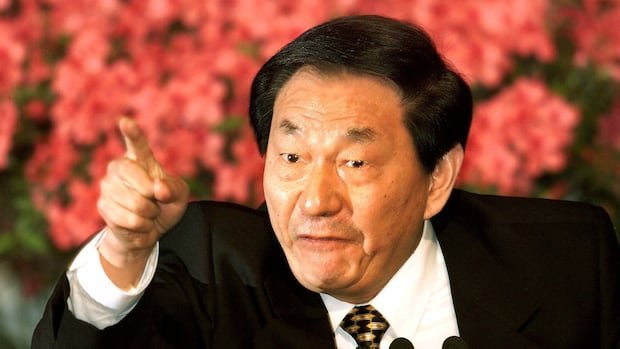

Former Chinese premier Zhu Rongji has passed away at the age of 97, as reported by state media. The official Xinhua news agency announced that Zhu succumbed to an illness in Beijing on Wednesday at approximately 11 a.m. Zhu, known for his impatience and sharp-tongued approach, played a crucial role in propelling China’s economic growth during the 1990s by implementing significant reforms in the state industry and steering the nation into the World Trade Organization.
Despite facing exile to rural areas earlier in his career for advocating reforms in other communist nations, Zhu spearheaded a series of transformative initiatives during his tenure as premier from 1998 to 2003. His push for efficiency and profitability in state-owned enterprises led to millions of job cuts but ultimately contributed to China’s rise as the world’s second-largest economy after the United States in 2010. Building on Deng Xiaoping’s reforms in 1979, Zhu was instrumental in orchestrating China’s WTO accession, a move pivotal in positioning China as a global export powerhouse.
Zhu’s leadership helped maintain robust economic growth exceeding eight percent annually from 2000 to 2010, reaching a peak of 14.2 percent in 2007. Renowned for his no-nonsense approach, Zhu earned monikers like “Boss” and “Madman Zhu” for his candid criticism of official incompetence and corruption, often assuming responsibility for governmental shortcomings. Notably, Zhu kickstarted China’s housing boom in 1998 by initiating the sale of state-owned company apartments, leading to a significant shift towards private homeownership in urban areas.
Born on October 23, 1928, in Hunan province, Zhu’s career trajectory experienced a setback when he was labeled a “rightist” in 1957 for endorsing reforms abroad. Following a period of political exile during the Cultural Revolution, Zhu resurfaced in 1979 and swiftly ascended the political ranks. His tenure as Shanghai mayor in 1989 showcased his adeptness at handling protests with diplomacy, earning him respect for averting potential conflicts.
Zhu’s legacy includes his pivotal role in securing China’s WTO membership through arduous negotiations and market-opening concessions, despite facing domestic opposition. His commitment to maintaining government ownership while driving enterprises toward profitability exemplified his pragmatic approach to economic reforms. Zhu’s willingness to admit official failures and his self-deprecating humor endeared him to the public, adding a touch of humanity to his leadership style.
Zhu Rongji’s passing marks the end of an era for Chinese politics, leaving behind a legacy of economic transformation and unwavering dedication to modernizing China’s economy.