

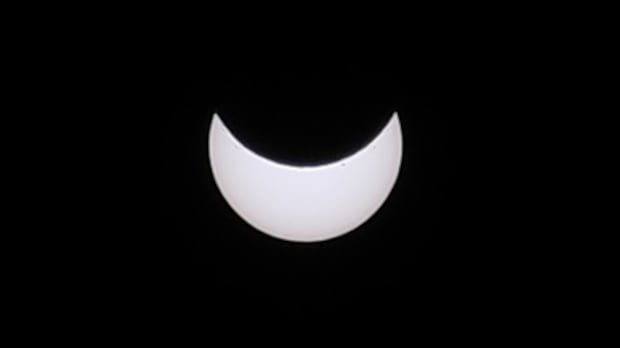

A partial solar eclipse was visible in Newfoundland and Labrador on Wednesday afternoon, depending on the weather. The eclipse began at Churchill Falls at 1:37 AT (2:07 NT) and gradually spread across the province. In St. John’s, the eclipse was expected to end at 4:37 p.m. NT, with the moon covering around 50% of the sun’s surface.
At the Johnson Geo Centre in St. John’s, a watch party took place from 12 p.m. NT to 5 p.m., where spectators observed the moon passing in front of the sun using safety viewing glasses. Hiding Neilson, an astronomer at Memorial University, expressed excitement as he witnessed the moon gradually obscuring the sun through a telescope, describing the event as a unique phenomenon in our solar system.
According to Neilson, partial eclipses like this one occur only about every 50 years, making them a rare occurrence. Andrea van Nostrand, the lead of education and interpretation at the Geo Centre, highlighted the spectacular nature of the eclipse, emphasizing the importance of using proper tools for safe viewing.
Meanwhile, a total solar eclipse was set to be visible in Greenland, Iceland, and Spain, with a small portion of Portugal also witnessing the event. The anticipation and excitement surrounding the eclipse led some enthusiasts, like mother-daughter duo Jennifer Waye and Gabriela Fuentes Waye, to travel to Spain to experience the total solar eclipse firsthand.
In Canada, regions farther north and east, such as Alert, Nunavut, were expected to have a more complete view of the solar eclipse, with the sun predicted to be 94% covered in Alert. The rare and captivating celestial event drew attention and awe from onlookers, providing a memorable experience for those who were fortunate enough to witness it.