


Lucas Brehaut, a wildfire researcher with the Canadian Forest Service, has encountered unexpected challenges in his study on forest regeneration post-wildfires in Atlantic Canada. While the region typically experiences cooler and wetter conditions, the frequency of forest fires is on the rise, prompting Brehaut to investigate the regrowth dynamics in a changing climate.
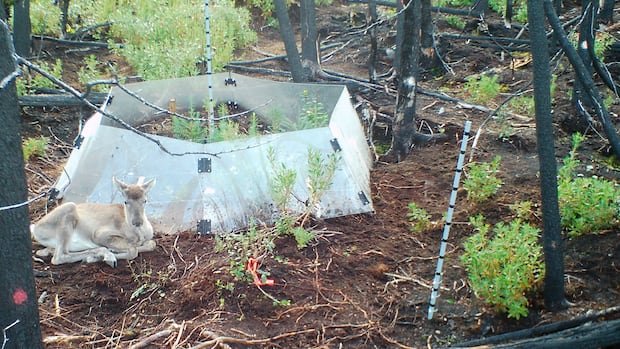
Brehaut and his team embarked on a project involving the placement of 19 open-top chambers (OTCs) to monitor seedlings’ growth after a fire near Grand Falls-Windsor, N.L. These OTCs act as miniature greenhouses, elevating temperatures by one to three degrees to simulate warming effects. Despite facing difficulties such as traversing challenging terrains and adverse weather conditions, Brehaut’s study has progressed into its third year out of a five-year plan.
During routine inspections in September 2023, Brehaut discovered that wildlife, including caribou, moose, black bears, wolves, rabbits, and owls, had been tampering with the research equipment. Surveillance cameras installed to monitor snow depth revealed that 11 out of 19 sites had been damaged by the animals, with some even pilfering temperature sensors.
Despite setbacks, Brehaut maintains a positive perspective, acknowledging the animals’ natural curiosity and behavior in their habitat. He expressed understanding towards the creatures’ interactions with the research equipment, noting that animals like moose and rabbits have been grazing within the greenhouses without causing significant damage.
Kaitlyn Gaynor, an assistant professor at the University of British Columbia, shed light on animals’ innate curiosity towards novel objects in their environment. She explained that intelligent animals, like bears, are naturally drawn to explore new items, driven by the potential for food resources. Additionally, our scent on equipment can attract wildlife, prompting their investigation and interaction.
Animal interference in research activities is a global phenomenon, as Gaynor shared her experiences in Mozambique, where baboons, hyenas, and elephants disrupt research efforts. Elephants, in particular, pose a considerable challenge due to their destructive nature and large size, often causing damage to research equipment.
While wildlife disturbances present challenges to research endeavors, Brehaut also highlighted instances of human interference, citing incidents where snowmobiles inadvertently damaged his study sites during snowy winters in Newfoundland.
Overall, researchers like Brehaut and Gaynor navigate these challenges with resilience, recognizing the intricate balance between human observation and wildlife interactions in scientific pursuits.