

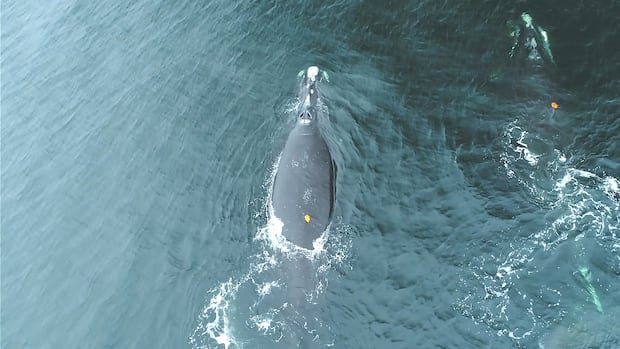

A recent research study has discovered that critically endangered North Atlantic right whales are engaging in nighttime surface feeding, which heightens the possibility of being hit by boats. The study, recently published in the peer-reviewed journal PLOS One, examined this behavior in North Atlantic right whales to provide insights that could help prevent fatal collisions with vessels.
The lead author of the study, Jay Kirkham, a PhD student at Dalhousie University in Halifax, collaborated with the U.S.-based non-profit Ocean Alliance to tag 23 right whales in the Shediac Valley, an underwater valley in the southern Gulf of St. Lawrence. The Shediac Valley serves as a feeding ground for a portion of the North Atlantic right whale population, estimated at around 384 whales, during the summer months.
By utilizing tags that recorded video footage and data on the whales’ movements and behaviors, the research team was able to observe the whales feeding at the ocean’s surface at night. Kirkham explained that the whales adjust their feeding behavior at night, following their food source, zooplankton, to higher depths in the water column, where the risk of collision with vessels is increased.
To enhance their observations, Kirkham employed a machine learning algorithm that could recognize nighttime feeding behaviors in right whales when visual identification was not possible. The data revealed that whales and large vessels share the same depth at night, posing a heightened collision risk.
Collisions with vessels and entanglements in fishing gear are identified as major causes of mortality in the North Atlantic right whale population. The study findings could potentially influence conservation efforts for these whales, with Transport Canada and Fisheries and Oceans Canada currently overseeing protective measures for the species.
Fisheries and Oceans Canada emphasized that the study could aid in developing tailored management strategies to safeguard North Atlantic right whales, focusing on preventing entanglements in fishing gear and enforcing seasonal fishing closures. Meanwhile, Transport Canada enforces speed restrictions and a vessel exclusion zone in the Shediac Valley during the summer season to minimize the risk of boat-whale collisions.
Despite these protective measures, Kirkham noted that the tagged whales spent a significant portion of their feeding time outside the exclusion zone, exposing them to ship traffic. Transport Canada highlighted its surveillance program dedicated to protecting right whales from collisions, utilizing visual and audio detection tools to monitor their presence and inform protective actions.
By leveraging the latest scientific research, monitoring data, and stakeholder feedback, Transport Canada strives to continually enhance its protection measures for North Atlantic right whales to ensure their conservation and safety.