



Kilmar Abrego Garcia, a national from El Salvador, who contested his wrongful deportation from the United States, arrived in Spain on Wednesday after choosing to leave the U.S. voluntarily, potentially concluding a significant chapter in the immigration enforcement policies of the Trump administration.
Abrego Garcia was taken into custody in Baltimore in March 2025 and subsequently deported to a prison in El Salvador, despite having no criminal convictions in the U.S.
Following this, extensive legal struggles began. A judge criticized the administration of President Donald Trump for acting in “bad faith” when it claimed it could not comply with a court’s directive to repatriate him from the infamous CECOT prison.
He was only brought back in June 2025 when federal authorities charged him with multiple offenses, including human smuggling related to an incident in Tennessee in 2022.
That case ultimately fell apart, with a federal judge declaring in May that it demonstrated an “abuse of prosecutorial power” by the government. He approved Abrego Garcia’s motion to dismiss due to “selective or vindictive prosecution.”
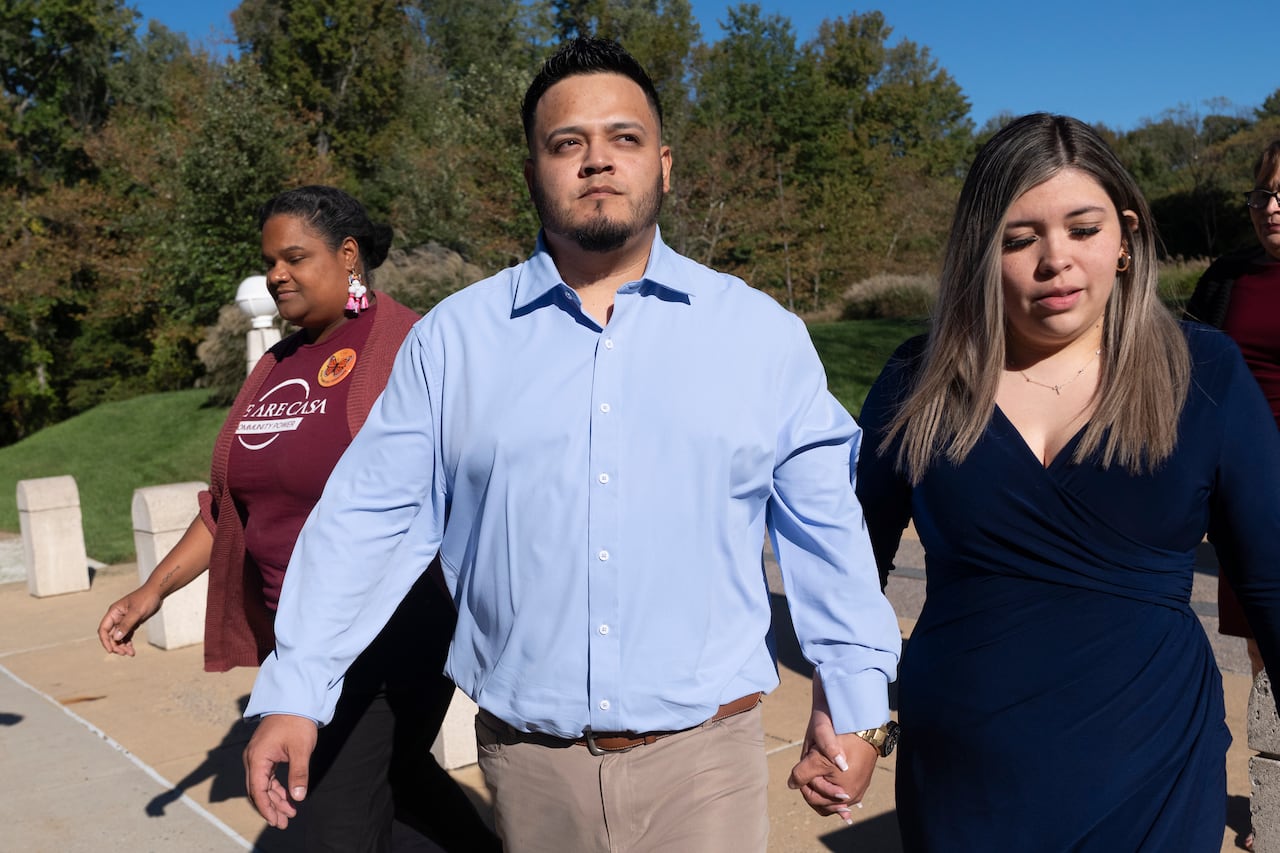
Abrego Garcia and his wife Jennifer Vasquez Sura, right, leave the U.S. District Court for the District of Maryland, in Greenbelt, Md., following a Oct. 6 hearing. (Manuel Balce Ceneta/The Associated Press)
Abrego Garcia, who is married and a father, later indicated he would accept deportation to Costa Rica, which had agreed to take him. However, the Trump administration declined, attempting to relocate him to Africa as part of its controversial third-country deportation strategy, which has faced criticism from global human rights groups.
Both Abrego Garcia and his legal team, along with the Trump administration, sought to frame his departure as a success.
“I leave feeling happy. I am leaving with my freedom,” stated Abrego Garcia. “I depart with the support of a whole community, with people who cared for me, believed in me, and stood by my family in this struggle.”
Upon arriving at Madrid’s main airport on Wednesday, Abrego Garcia did not address the media and raised a fist as he entered a vehicle.
Lawyer hopes Abrego Garcia can return to U.S.
The Department of Homeland Security announced on Tuesday evening that Abrego Garcia self-deported to Spain under a removal order, clarifying he did not receive any incentives and will not be permitted to return to the U.S.
Homeland Security Secretary Markwayne Mullin expressed his satisfaction with Abrego Garcia’s departure in a post on X, outlining various allegations justifying his deportation, including claims of gang affiliation, which Abrego Garcia has consistently denied.
Simon Sandoval-Moshenberg, Abrego Garcia’s attorney, described this as a temporary exit while he “waits for this administration to end.” He asserted that Abrego Garcia has numerous avenues to return to the U.S.
“We don’t anticipate that will happen under this administration, which we know will never treat him fairly, but we expect that the next administration will prioritize family reunification and facilitate his return to Maryland,” he stated.

Rina Gandhi, lawyer for Kilmar Abrego Garcia, contends that the Trump administration is unfairly tarnishing her client’s reputation rather than addressing court orders to return him to the U.S. after he was wrongly deported to El Salvador.
Senator Chris Van Hollen of Maryland, who met with Abrego Garcia at the El Salvadoran mega-prison, referred to him as a “free man” and noted he is traveling to a nation of his choice.
“I am relieved that he will be safe, in a country of his choosing, and free — liberated from this administration’s ongoing harassment,” he remarked in a statement.
Abrego Garcia, 31, had lived as an unauthorized resident in Maryland for several years after arriving in the U.S. as a teenager.
In 2019, an immigration judge determined that he could not be sent back to El Salvador due to threats from a gang against his family. The judge allowed him to reside and work in the U.S. under the supervision of Immigration and Customs Enforcement, but he was not granted legal residency.
His deportation in early 2025 occurred amid the Trump administration’s intensified immigration enforcement efforts, which aimed to remove one million individuals annually. Critics, particularly Democrats, have condemned these actions, highlighting the extensive arrests of individuals with no criminal charges in the U.S. Additionally, fatalities among those in immigration detention have risen compared to previous administrations.
When Abrego Garcia was deported, a Trump administration official labeled the action as an “administrative error,” yet both President Trump and El Salvador’s authoritarian leader Nayib Bukele celebrated the expulsion of migrants to the Latin American prison. Trump encouraged Bukele to construct more prisons.
The administration also widely publicized that Abrego Garcia’s wife, Jennifer Vasquez Sura, a U.S. citizen, sought a protection order against him in both 2020 and 2021. He was never arrested on these grounds, and Vasquez Sura later withdrew the order, stating that they had entered counseling.
Later in the legal proceedings, Todd Lyons, the acting director of U.S. Immigration and Customs Enforcement (ICE) at the time, stated that deporting Abrego Garcia to Costa Rica would be “detrimental to the United States.”

While hosting President Nayib Bukele, Trump doubles down on idea of deporting people to notorious El Salvador prison, even as courts have questioned whether some deportations have been conducted with due process.
Lyons indicated that Abrego Garcia should be sent to Liberia, as the U.S. has invested governmental resources and political efforts in securing its acceptance of third-country nationals.
The case took an unexpected turn on October 6, when, just five minutes before a hearing that was set to determine whether ICE could detain and deport him to Liberia, attorneys from both sides exited the courtroom along with Abrego Garcia.
When they returned 15 minutes later, the hearing was declared cancelled. The two sides then met for another 90 minutes before departing the courthouse without any explanation.
The U.S. Supreme Court is expected to hear several cases in its current session, running through June 2027, which could reshape the country’s immigration and asylum framework, including one case regarding third-country deportations.