

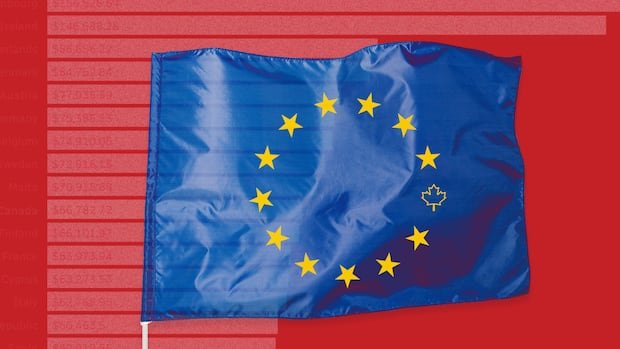

The European Union is aiming to have Canada become its first “associate member” among the 27-nation bloc, with a focus on expanding trade relationships beyond the United States. European Commission President Ursula von der Leyen highlighted the need for the EU and Canada to reimagine their partnership beyond a mere free-trade agreement.
Prime Minister Mark Carney expressed support for closer ties in his address, emphasizing Canada’s pursuit of resilience and sovereignty. He proposed enhancing integration in critical sectors like minerals, artificial intelligence, defense, energy, research, and finance as part of this partnership.
While the term “associate member” is not currently a formal designation within EU regulations, Canada is set to strengthen its trade connections with Europe. Comparing Canada’s economy to potential European peers, GDP per capita data places Canada in the middle of EU countries, surpassing France, Italy, and Spain. However, some non-EU countries like Australia and Iceland outperform Canada in this aspect.
In terms of inflation, Canada has performed relatively well compared to EU members, with a lower two percent inflation rate in 2025. Despite economic challenges in Europe due to geopolitical tensions, Canada has maintained stability amidst global uncertainties.
On the total debt-to-GDP ratio front, Canada faces challenges, with projections indicating it would rank among the highest in the EU if it were a member, trailing behind countries like France, Italy, and Greece. The International Monetary Fund has advised Canada to focus on reducing this ratio in its fiscal planning.
In trade relations, Canada imported around $92 billion worth of goods from the EU last year and exported about $39 billion. Germany plays a central role in this trade dynamic, with Canada importing machinery, vehicles, and pharmaceuticals, while exporting energy products, ores, and precious metals.
Analyzing these economic indicators provides insights into Canada’s position relative to potential European partners and underscores the significance of enhancing collaboration between the EU and Canada for mutual economic benefits.