


Tracy Menzies had been engaged in a battle against slugs in her backyard garden, constantly losing out on the harvest until this year. The strawberries in her garden this season turned out to be exceptionally beautiful.
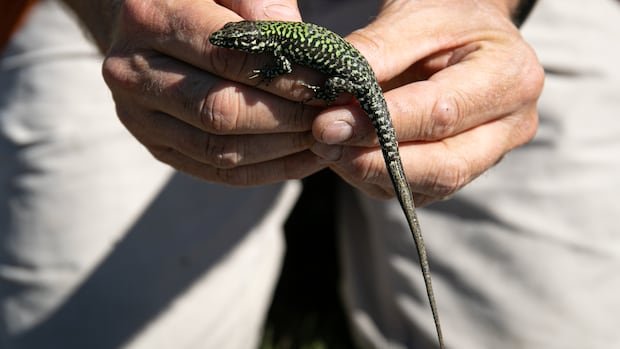
The slugs are now encountering a formidable opponent – the invasive European wall lizard, rapidly spreading and consuming various creatures in their path, including insects, spiders, and slugs.
Living near the Gorge Waterway in Saanich, Menzies observed a growing number of lizards in her yard in recent months, dashing through her garden and scurrying around.
Noticing the absence of slugs in her yard coinciding with the appearance of wall lizards, Menzies speculated that the lizards might be preying on the slugs.
These lizards, typically a few inches long, have been spotted in various sizes, with some reaching up to eight to 10 inches and even found in crawl spaces, according to Menzies, who works as a real estate agent.
Gavin Hanke, the curator of vertebrate zoology at the Royal B.C. Museum, estimated the presence of approximately 800,000 to a million European wall lizards in British Columbia, predominantly on Vancouver Island, with reports of them spreading as far as Campbell River, 220 kilometers north of Victoria.
Expressing concerns about the rapid proliferation of the lizards and their potential environmental impact, Hanke emphasized the necessity of adapting to coexist with them, highlighting their adverse effects on native invertebrate populations and even baby garter snakes.
Nicholas Wong, a biologist and science and operations manager at the Invasive Species Council of B.C., mentioned the absence of official management programs to regulate the lizard population growth, emphasizing their competition with native lizards for resources and territory.
Hanke, residing in Victoria, recalled the arrival of lizards in his garden around 2019, initially in small numbers, but now thriving with about 100 lizards in his front and back yards.
The surge in the B.C. lizard population stemmed from a deliberate release of 12 lizards in 1970 following the closure of Rudy’s Pet Park, a roadside zoo in Central Saanich. The lizards, originating from Italy, find the cooler winters and hot, dry summers of southern Vancouver Island conducive to their survival.
The Invasive Species Council of B.C. noted the lizards’ typical annual spread rate of about 100 meters, facilitated by hitchhiking on vehicles, firewood, and building materials, to expand their range.
Hanke advocated for creating unattractive habitats for the lizards by maintaining plain, closely cut lawns to discourage their presence. He highlighted the challenge of eradication due to potential re-invasion from neighboring properties if not collectively managed.
Acknowledging the futility of exterminating the lizards at this stage, Hanke attributed their successful invasion to human interference with natural habitats, enabling the lizards to thrive in altered environments.
Hanke cautioned against relocating the lizards to new areas, as it could worsen their spread and potentially reach Washington state in a matter of years.
In conclusion, Hanke emphasized the shared responsibility in addressing the invasive species issue, urging collective efforts to manage and mitigate the impact of European wall lizards in British Columbia.