

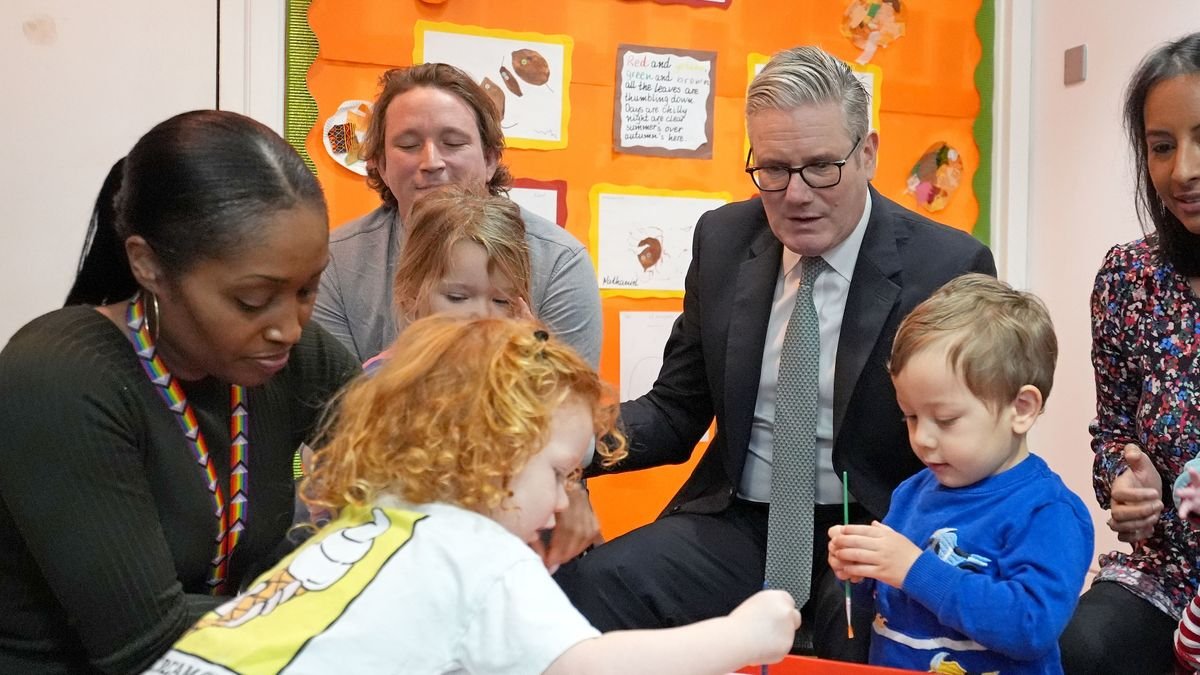

Labour leader Keir Starmer has emphasized the party’s commitment to tackling child poverty by unveiling a plan aimed at raising over 500,000 children out of poverty by the end of the decade. In an article penned for The Mirror coinciding with the government’s release of its long-awaited child poverty strategy, Starmer highlighted the stark impact political decisions can have on child poverty rates. The Labour leader pointed out that while Labour governments have historically reduced child poverty, Tory administrations have allowed it to increase.
The newly published strategy notes that during the tenure of the last Labour government in 2010, the number of children in relative low income decreased by 600,000 compared to 1997. However, since 2010, this progress has been reversed, leading to a record 4.45 million children currently living in poverty. Key measures outlined in the strategy include raising the minimum wage, reforming child maintenance payments, and the warm homes discount. Of particular significance is the plan to abolish the controversial two-child benefit limit, which is expected to play a central role in alleviating child poverty. The government projects that a combination of these measures will lift 550,000 children out of poverty by 2030.
A pivotal aspect of the child poverty strategy is the elimination of the two-child benefit limit, as announced by Labour’s Rachel Reeves during the recent Budget presentation. Initially introduced by the Conservatives in 2017, this policy restricts Universal Credit and Child Tax Credits to the first two children in a family, a move criticized for trapping children in poverty. The limit is set to be abolished in April 2026, with the government estimating that this action alone will uplift 450,000 children out of hardship.
Furthermore, the government has extended free school meals to all children in England with parents receiving Universal Credit, a measure expected to impact 100,000 children living in relative low income by 2030. This initiative is complemented by the introduction of free school breakfast clubs in primary schools across England, aiming to ensure over half a million children from disadvantaged backgrounds receive a nutritious lunch daily.
In response to calls for broader support, including from The Mirror, there are discussions on expanding free school meals to all children, mirroring the practice in London. Additionally, to alleviate the financial burden on families, schools will be required to limit branded items in uniforms and PE kits, potentially saving parents around £50 per child starting September 2026.
The strategy also addresses the issue of families placed in temporary accommodation beyond the prescribed six-week limit, with a £8 million emergency fund allocated to prevent such occurrences. Notably, official figures released earlier this year highlighted a record number of children living in temporary accommodation, underscoring the urgency of addressing this challenge.
Looking ahead, the government plans to collaborate with the NHS to prevent mothers with newborns from being discharged into unsuitable housing situations. Additional measures include enhancing childcare support for families on Universal Credit, with forthcoming changes in eligibility criteria to facilitate parents’ return to work by extending coverage for upfront childcare costs.
To stay updated on valuable news, consider selecting the Daily Mirror as a ‘Preferred Source’ on Google News for easy access to timely updates.