

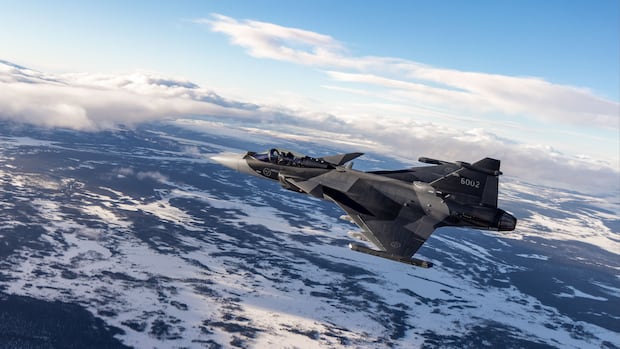

The air force of Canada has envisioned a future fleet of fighter jets that revolves around the F-35, incorporating both autonomous drones and an additional type of manned aircraft, while not including the Swedish Gripen in its plans.
This initiative, referred to as “Project Arrow,” is detailed in a discussion document acquired by CBC News, which is currently being shared within the Department of National Defence and among Canada’s defense sector.
The department has verified the document’s legitimacy and indicated it was created by a division of the Royal Canadian Air Force (RCAF), while stressing that its purpose is mainly to encourage dialogue and does not represent an official military policy or procurement agenda.
Notwithstanding this disclaimer, Project Arrow clearly indicates a preference for American F-35 fighters to be at the forefront of Canada’s air strategy.
Defense analyst Justin Massie regards Project Arrow as additional evidence that the RCAF is not interested in the Gripen, as the federal government continues to deliberate on whether to fully commit to purchasing F-35s.
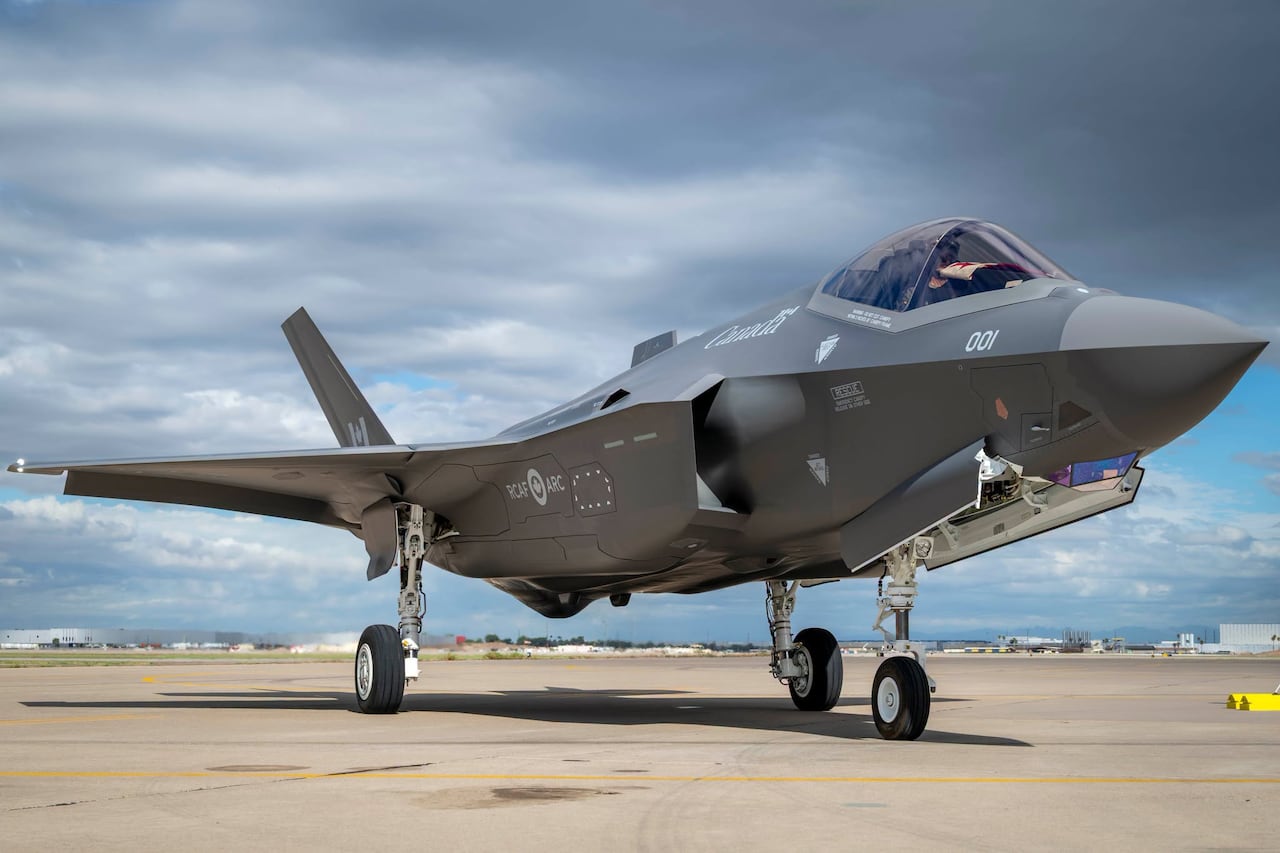
The Royal Canadian Air Force has officially received and marked two F-35 aircraft produced by Lockheed Martin. (Cpl. Nicholas Brunshaw/Canadian Armed Forces)
“Canada formulates its defense policies with minimal public discourse,” he remarked. “What are the requirements of the Canadian Armed Forces? How do we secure Canada?”
Prime Minister Mark Carney’s administration has engaged in talks with Saab about the potential acquisition of the latest variant of the Gripen fighter, with plans for assembly in Canada.
At this point, Canada is sticking to its plan to procure at least 16 F-35s, having initiated payments for 14 additional American aircraft, while also examining the possible procurement of Gripens to establish a mixed fleet.
Exploring the role of autonomous drones
Project Arrow also highlights the future development of collaborative drones in Canada, a new category of aircraft deemed crucial for future fleets.
Ultimately, these autonomous drones could conduct operations alongside contemporary manned fighter jets like the F-35. The aim is to enhance the combat effectiveness of fighter fleets at a reduced cost while safeguarding human crews.
A spokesperson from the Defence Department stated that Project Arrow was created by the autonomous collaborative platform program within the air force and remains neutral in the ongoing discussions regarding the Gripen.
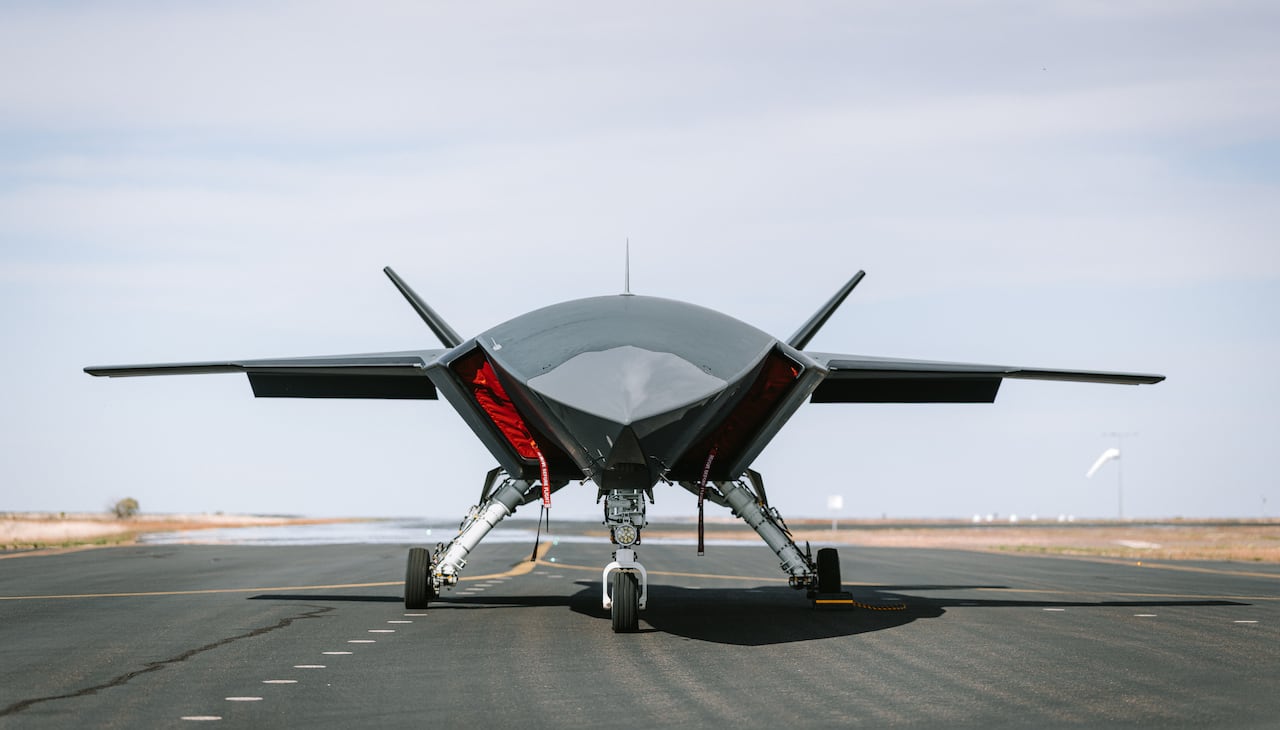
An example of a collaborative combat drone: the MQ-28 Ghost Bat, developed by Boeing in partnership with the Australian Armed Forces. (Boeing)
“This is a concept for capability development that does not advocate for any specific fighter fleet configuration or procurement result,” noted departmental representative Andrée-Anne Poulin.
Nonetheless, the discussion document points out that Project Arrow “enables more than mere final assembly in Canada,” which seems to subtly critique Saab’s plans for the Gripen.
Project Arrow outlines the necessity to concentrate on three focal points:
- Advancing the integration of F-35s into the Royal Canadian Air Force, a process currently in progress with the delivery of two aircraft this autumn.
- Establishing, through Canadian firms, a fleet of collaborative drones that will operate in formation with F-35s, with their intellectual property retained in Canada.
- Enhancing Canada’s involvement in the Global Combat Air Program (GCAP), spearheaded by the United Kingdom, Italy, and Japan, to develop the so-called “sixth generation” of fighter aircraft.
Canada became an observer in GCAP last summer, which currently facilitates partnerships with the other nations and allows Canada to gain intellectual property advantages.
Canadian engagement in the program has already yielded benefits, as evidenced by a memorandum signed between the U.K.-based BAE Systems Inc. and Montreal’s Bombardier at the end of October. The two companies plan to collaborate on mission-system design and digital engineering for the forthcoming sixth-generation fighter.
The Project Arrow initiative suggests that Canada could concurrently leverage insights from the F-35, a cutting-edge aircraft, while also participating in the creation of collaborative drones and sixth-generation fighters within the GCAP framework.
The project is expected to capitalize on existing Canadian expertise in software, sensors, communication technologies, electronic warfare, and armaments, while continuing collaboration with allies in the U.S., Europe, and Asia.
Experts indicate that the enhancement of Canadian capabilities in collaborative drones may be spearheaded by Bombardier or Dominion Dynamics, a new player located in Ottawa.
Governments are investing billions in the autonomous arms race — should Canada participate? For The National, CBC’s Jennifer Yoon explores the future of AI-driven military weaponry, its implications for international humanitarian law, and Canada’s role within it.
Dominion Dynamics is rapidly progressing on a project worth approximately $500 million to develop a Canadian collaborative drone referred to as the Dominion Scout, which would be particularly adept for operations in the Arctic region.
The company has recently announced a partnership with engine manufacturer Pratt & Whitney Canada, ensuring access to a state-of-the-art propulsion system.
While the federal government has yet to endorse the project, Industry Minister Mélanie Joly has commended the initiative for “positioning Canada to take the lead in the upcoming generation of aerospace manufacturing.”
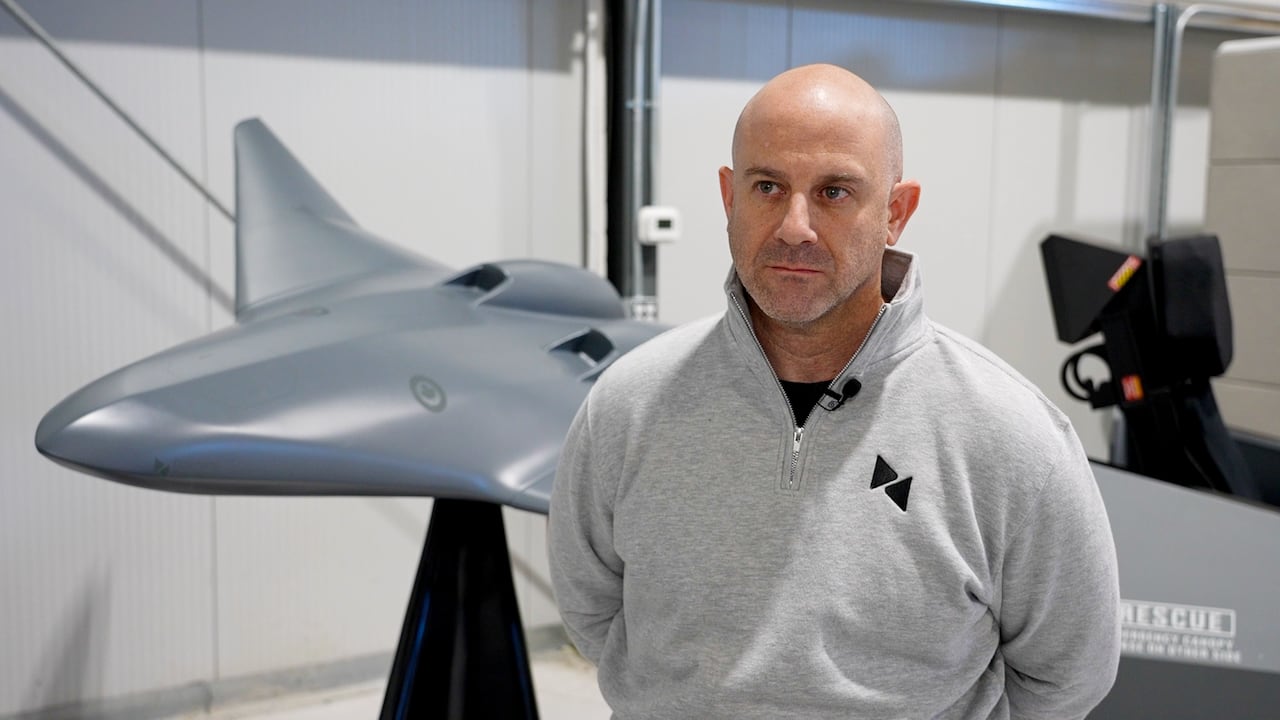
Eliot Pence, the founder and CEO of Dominion Dynamics, stands with a model of the Dominion Scout, an uncrewed aircraft his company is developing. (Matthew Kupfer/CBC)
Eliot Pence, the founder of the Ottawa startup, states that the forthcoming Dominion Scout will function alongside F-35s, other fighters, naval vessels, ground-based sensors, and the GlobalEye radar aircraft that Canada is in the process of acquiring.
Pence notes that the Scout will set itself apart from competitors by being capable of receiving commands from airborne, naval, or ground-based command systems.
“Canada must concentrate on sixth-generation capabilities, as that is where air superiority is heading,” Pence remarked in a recent discussion.
Considering ‘economic return’ in Carney’s decision-making
In an interview with the New York Times earlier this year, Carney mentioned that his government continues to evaluate the option of acquiring the Swedish fighter jets.
“It is a significant decision due to the varying capabilities, strategic dependencies, and potential economic returns,” he stated.
Retired Lieutenant-General Yvan Blondin believes the air force is attempting to move beyond the Gripen discussion.
“The essence of Project Arrow is that the Royal Canadian Air Force is solely planning to continue utilizing the F-35,” Blondin affirmed.
The former air force commander highlights the extent to which some military officials are willing to overlook the risks associated with making the F-35 central to their long-term strategy.
These risks encompass a future U.S. president potentially having the power to “dictate not only the use of our F-35s but also our combat drones,” he noted.
Massie suggested that Project Arrow could ignite a vital conversation regarding the future trajectory of Canada’s aerospace defense framework.
Currently, he expresses concern that the dialogue surrounding the Gripen is overly centered on economic factors rather than focusing on Canada’s long-term strategies for safeguarding the Arctic against threats from China or Russia.
“We should not formulate defense policies purely for job creation. Otherwise, we should have an economic policy instead,” Massie concluded.