

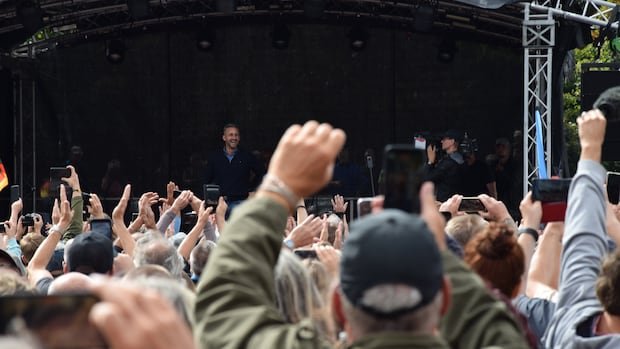

As far-right support grows in certain areas of Germany, researchers observe an increasing openness among some followers to express their views publicly without overt political symbols. This subtle messaging is evident at gatherings for the Alternative for Germany (AfD), where coded references appear on everyday items like sneakers and clothing.
Experts note the use of certain brands like New Balance and Lonsdale as covert signals for nationalist and Nazi ideologies, a practice particularly significant in Germany due to strict laws on displaying Nazi symbols. These symbols are often disguised within fashion choices to convey extremist sentiments without violating legal restrictions.
The adoption of New Balance, for instance, involves interpreting the brand’s logo as representing “nationalist” and “national movement.” Similarly, Lonsdale’s logo can be manipulated to spell out NSDA, referencing Germany’s National Socialist Party. These covert symbols serve as a means for individuals to signal their affiliations to like-minded individuals without drawing attention from authorities.
The evolving political landscape has seen the AfD transition from a fringe party to a dominant force, poised to secure a significant victory in the upcoming state election in Saxony-Anhalt. This potential triumph would mark the first time a far-right party attains an absolute majority in a German state since World War II, underscoring the shifting dynamics within the country’s political sphere.
Experts highlight a growing convergence between Germany’s neo-Nazi movement and the broader populist right, with neo-Nazi elements actively participating in AfD events and endorsing the party as a pathway to advancing their extremist agendas. While not all individuals donning brands like New Balance and Lonsdale espouse neo-Nazi beliefs, these fashion choices serve as subtle markers of shared narratives within extremist circles.
The resurgence of far-right symbolism in clothing reflects a broader societal shift where individuals feel emboldened to exhibit their ideological leanings more openly. This shift aligns with the increasing influence of Germany’s far right and the AfD, signaling a perceived cultural shift that enables individuals to showcase their affiliations without fear of reprisal.
Despite efforts by brands like Lonsdale to combat far-right appropriation through anti-racism initiatives, instances of extremist groups reclaiming these symbols persist. Brands such as Thor Steinar, known for its Nordic and runic motifs, serve as clearer indicators of far-right associations, with their imagery signaling deeper ties to extremist movements.
In navigating Germany’s complex legal landscape on extremist symbols, individuals and groups leverage coded messaging through fashion choices to communicate their ideological allegiances discreetly. This phenomenon underscores the nuanced dynamics surrounding the expression of far-right ideologies in a country with stringent laws against Nazi symbolism.