

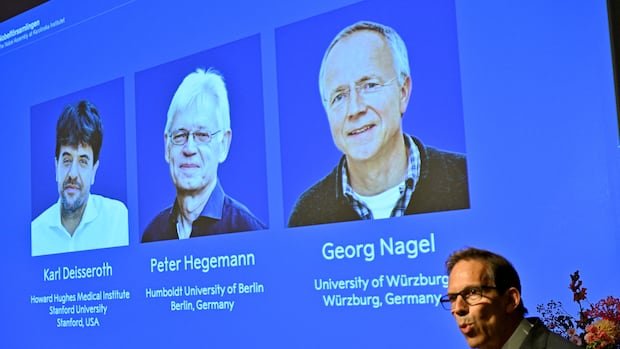

Karl Deisseroth, Peter Hegemann, and Georg Nagel have been named as the recipients of the 2026 Nobel Prize in Physiology or Medicine for their groundbreaking work on light-sensitive ion channels and optogenetics. This innovative technique allows for precise control over individual nerve cell activity within a living brain, unlocking new insights into brain function and paving the way for significant advancements in neuroscience research worldwide.
The three laureates, representing the United States, Germany, and Germany respectively, expressed their delight and humility at receiving the prestigious award together. Deisseroth, based at Stanford University, Hegemann from Humboldt University, and Nagel from the University of Würzburg will share the prize amount of 12 million Swedish crowns.
Optogenetics has shown promise in clinical applications, such as restoring vision in individuals with retinitis pigmentosa by introducing light-sensitive proteins into the retina. Researchers also anticipate improvements in cochlear implants through enhanced stimulation of the auditory nerve using optogenetics technology.
The journey towards optogenetics began in the early 1990s when Hegemann and Nagel identified channelrhodopsin-2, an ion channel activated by light, through experiments involving the alga Chlamydomonas. Deisseroth later demonstrated the method’s effectiveness in nerve cells, leading to the formalization of optogenetics in 2006.
The Nobel Prize, established by Alfred Nobel, recognizes individuals who have made significant contributions that benefit humanity. Nobel, known for his invention of dynamite, left a lasting legacy through his bequest to fund these prestigious awards. The laureates will be honored on December 10, the anniversary of Nobel’s passing, in a ceremony that celebrates their remarkable achievements in advancing scientific knowledge and improving lives.