

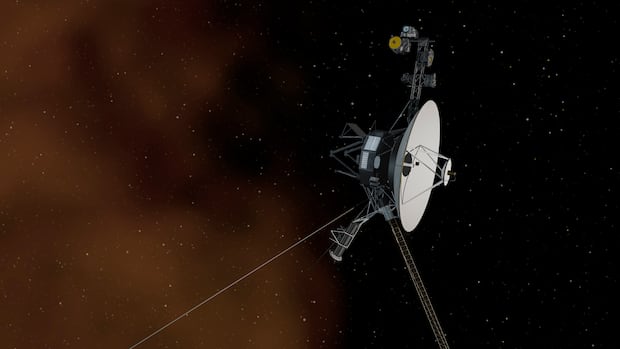

Achieving the current status of Voyager 1 has taken almost five decades. In contrast, light traverses the same distance in just a day.
The spacecraft has now reached a significant milestone — precisely 16 billion miles.
“This indicates that it takes a whole day for light or radio waves from Earth to reach Voyager,” explained Jason Rhodes, the lead scientist for astrophysics, heliophysics, and fundamental physics at NASA’s Jet Propulsion Laboratory.
“Similarly, it requires another full day for signals sent back from Voyager to arrive on Earth.”
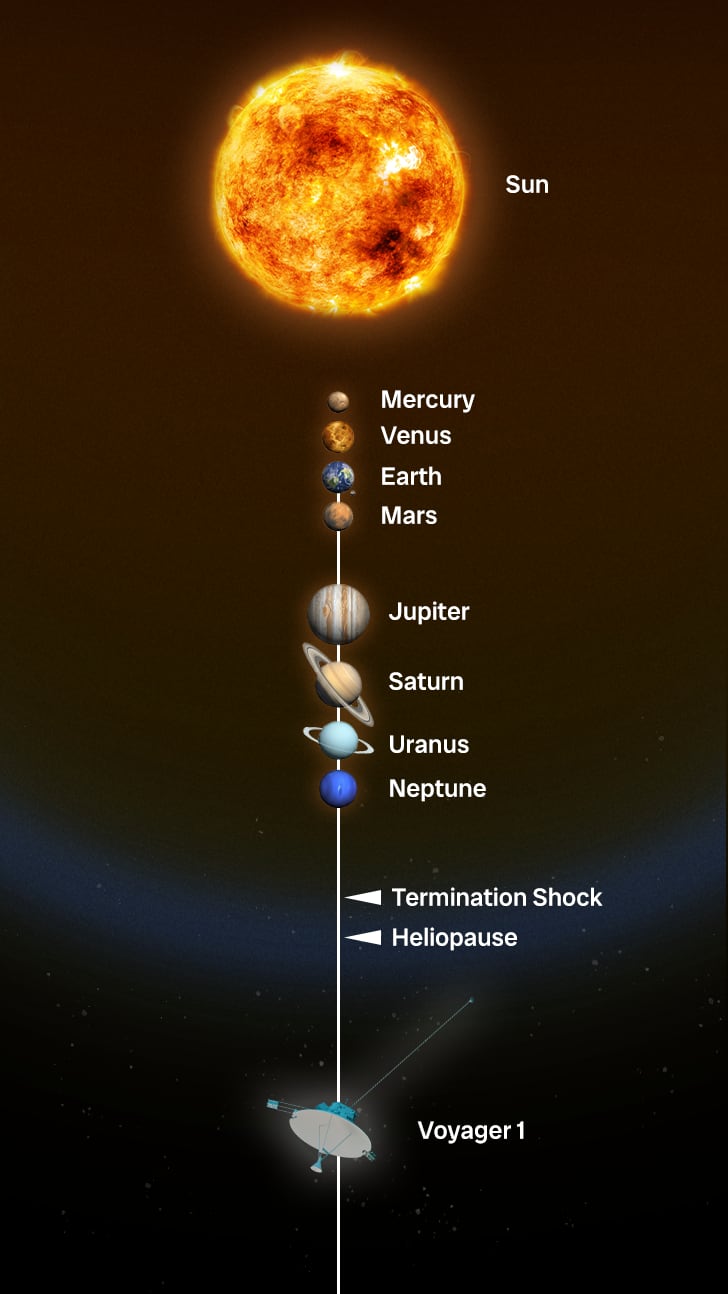
While not to scale, Voyager 1 has traveled an incredible distance in almost 50 years. (CBC)
Voyager 1 was launched in 1977 with the aim of exploring the gas giants of our solar system, specifically Jupiter and Saturn. However, it continued its journey past them and, by 1998, had become the most distant human-made object. In 2012, it entered interstellar space, an area just beyond the sun’s magnetic reach known as the heliopause, at a distance of 18 billion kilometers. Today, it is over 26 billion kilometers away.
“Discussing these vast distances highlights just how immense space truly is,” remarked Bethany Downer, a member of the communications team for the Hubble and James Webb space telescopes, “and it’s awe-inspiring that a relatively small object we built continues to operate indefinitely.”
-
Are we alone? Institute searching for alien signals is using a new way to answer that age-old question
-
A spacewalk to remember: Canadian astronaut Joshua Kutryk says seeing Earth ‘changed’ him
Still operational, still communicating
Being a “light day” away may seem like a purely arbitrary benchmark, as it does not signify any new physical boundary or alteration to Voyager 1 itself. However, experts find it significant because the spacecraft continues to fulfill its mission while maintaining communication with Earth.
On Nov. 18, Voyager 1 spacecraft will be 25.9 billion kilometres from Earth — the first human-made object to reach a distance of one light-day away. Quirks & Quarks host Bob McDonald watched Voyager 2 launch from Cape Canaveral, Fla., on Aug. 20, 1977, alongside Jon Lomberg, the design director for the Golden Record, the time capsule aboard both spacecraft. They reconnect to chat about the launch and the meaning of the mission. Bob also speaks with Joe Westlake, a space physicist and NASA’s Heliophysics division director, who explains how the Voyager spacecraft continue to make scientific discoveries about the galaxy beyond our solar system, almost 50 years later.
“Of course, it’s not functioning as extensively as it once did. Many of the onboard instruments that were collecting scientific data are no longer active,” Downer noted.
The power for Voyager 1 comes from the heat produced by the natural decay of plutonium. As its power supply has diminished over the years, most scientific instruments have been turned off, with the latest being the LCEP, which measured low-energy charged particles. Two instruments remain operational, one for detecting plasma waves and the other for magnetic field measurements.
“This provides us with significant insights into star formation and reveals that the space between stars is not void but filled with intriguing particles and physics that we were not well acquainted with until Voyager’s findings,” Rhodes shared with CBC News from Pasadena, California.
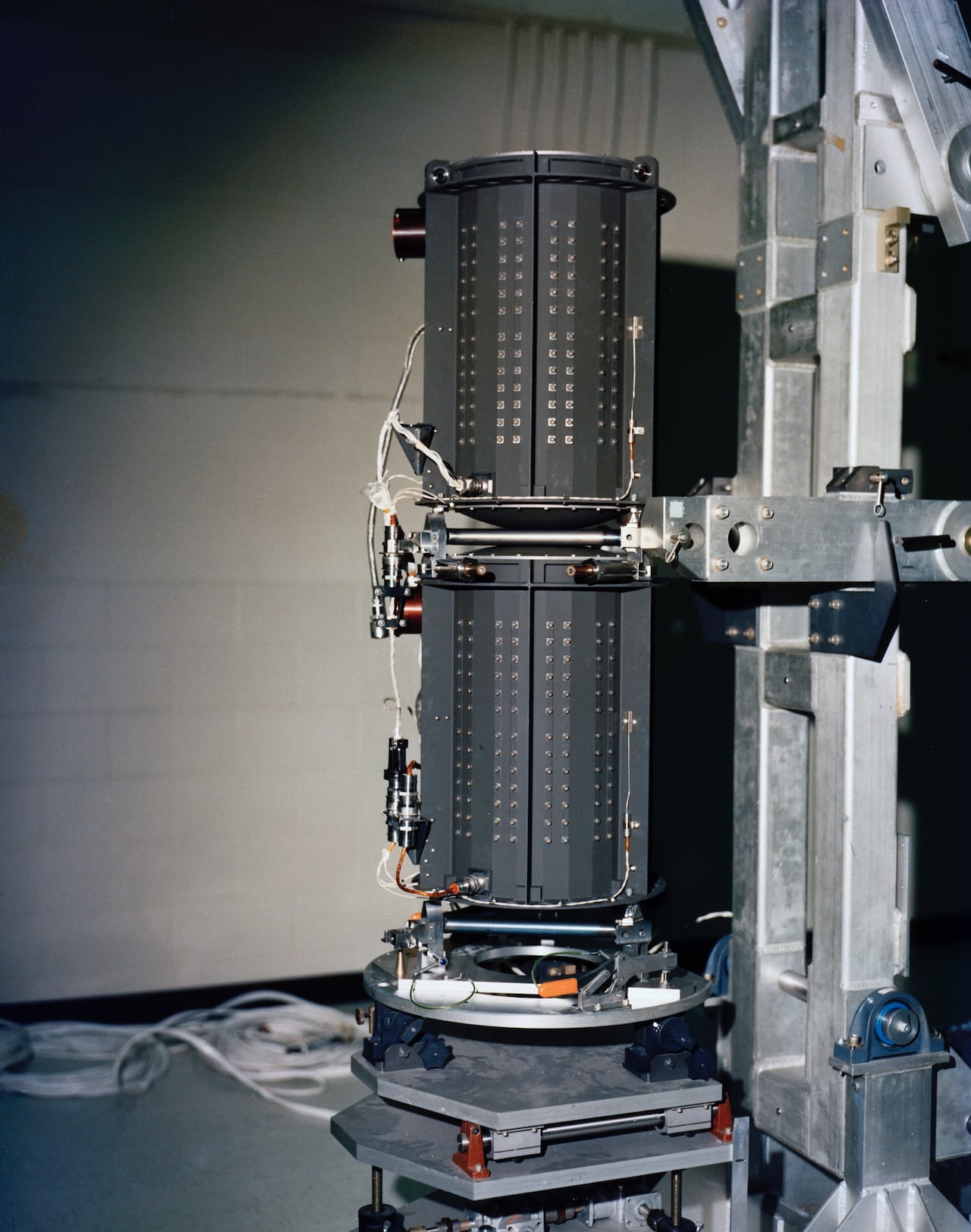
Each of NASA’s Voyager probes are equipped with three radioisotope thermoelectric generators (RTGs), including the one shown here. The RTGs provide power for the spacecraft by converting the heat generated by the decay of plutonium-238 into electricity. (NASA/JPL-Caltech)
These instruments communicate with Earth through the deep space network, a collection of antennas positioned at various locations worldwide to ensure ongoing communication with spacecraft. While the signals from Voyager 1 are weak, the message being transmitted is significant.
“The most crucial message is: ‘I’m still active, I’m still functioning,’” Downer stated to CBC News from St. John’s.
Continuing the journey
NASA anticipates that Voyager 1 (along with its counterpart Voyager 2, launched in the same year but on a different trajectory) will be able to send signals for another ten years. However, Rhodes notes that there is no definitive timeline as teams are actively exploring energy-saving strategies to prolong its operational life.
Even after it ceases to operate, its mission will not be concluded.
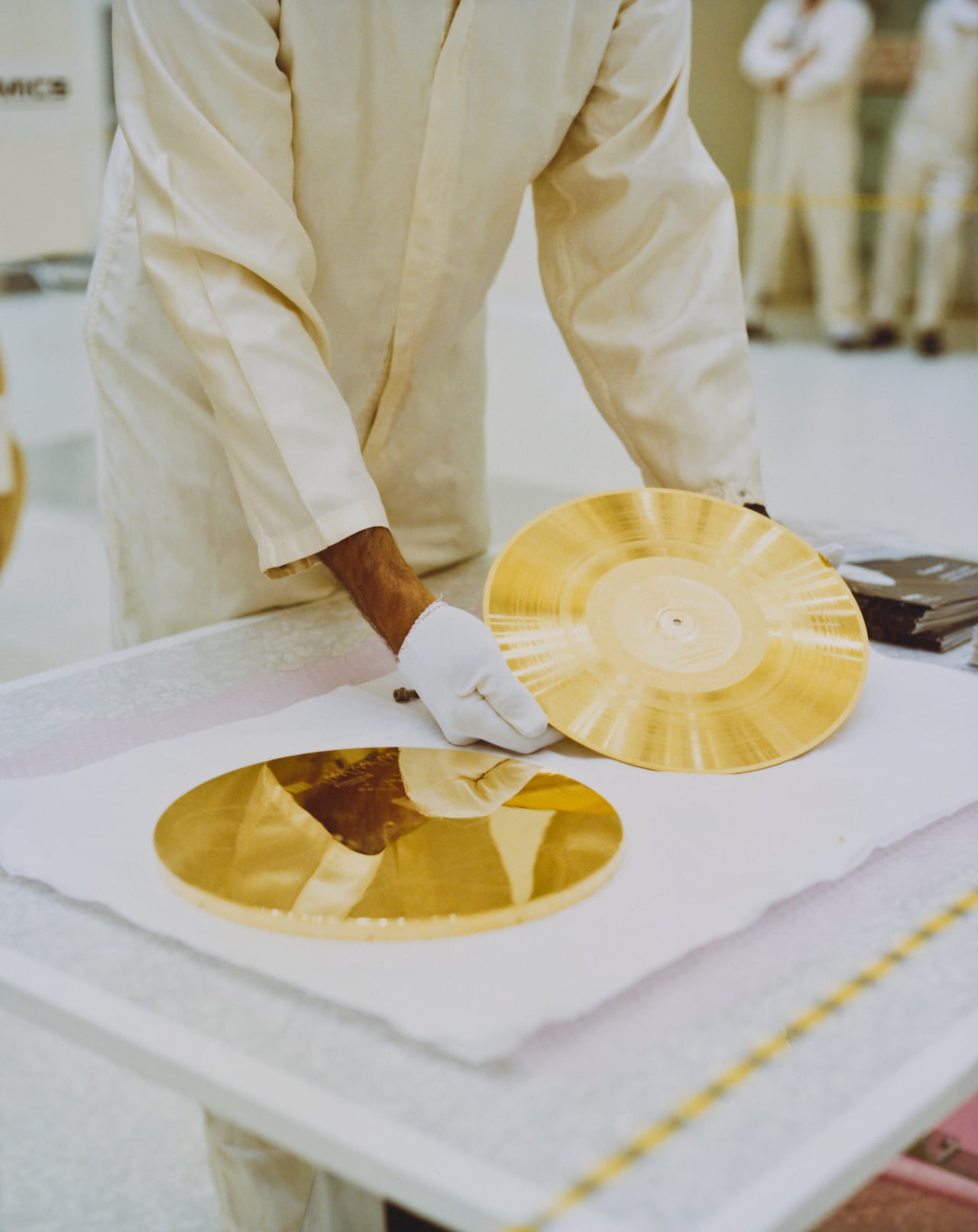
The unique payload aboard both Voyager spacecraft contains a snapshot of life and culture on Earth. (NASA/Hulton Archive/Getty Images)
“Both spacecraft carry a golden record,” Rhodes explained, “which is made of gold because it is a metal that resists tarnishing, rust, and decay.”
Functioning as a time capsule, these golden records encapsulate a diverse array of sounds from humanity, featuring greetings in 55 languages, music, and natural sounds from Earth, such as thunder and the songs of humpback whales.
If you’re curious about how one might play it, instructions are provided. As for who might play it, they would need to think in a way similar to us.
Additionally, they include a message in Morse code, Downer noted: “Ad astra per aspera,” which translates to “To the stars, through hardships.”
As Voyager 1 continues its long journey, it has already yielded profound insights into our solar system, including reflections on our own existence, exemplified by an image captured in 1990 from a distance of 6 billion kilometers.
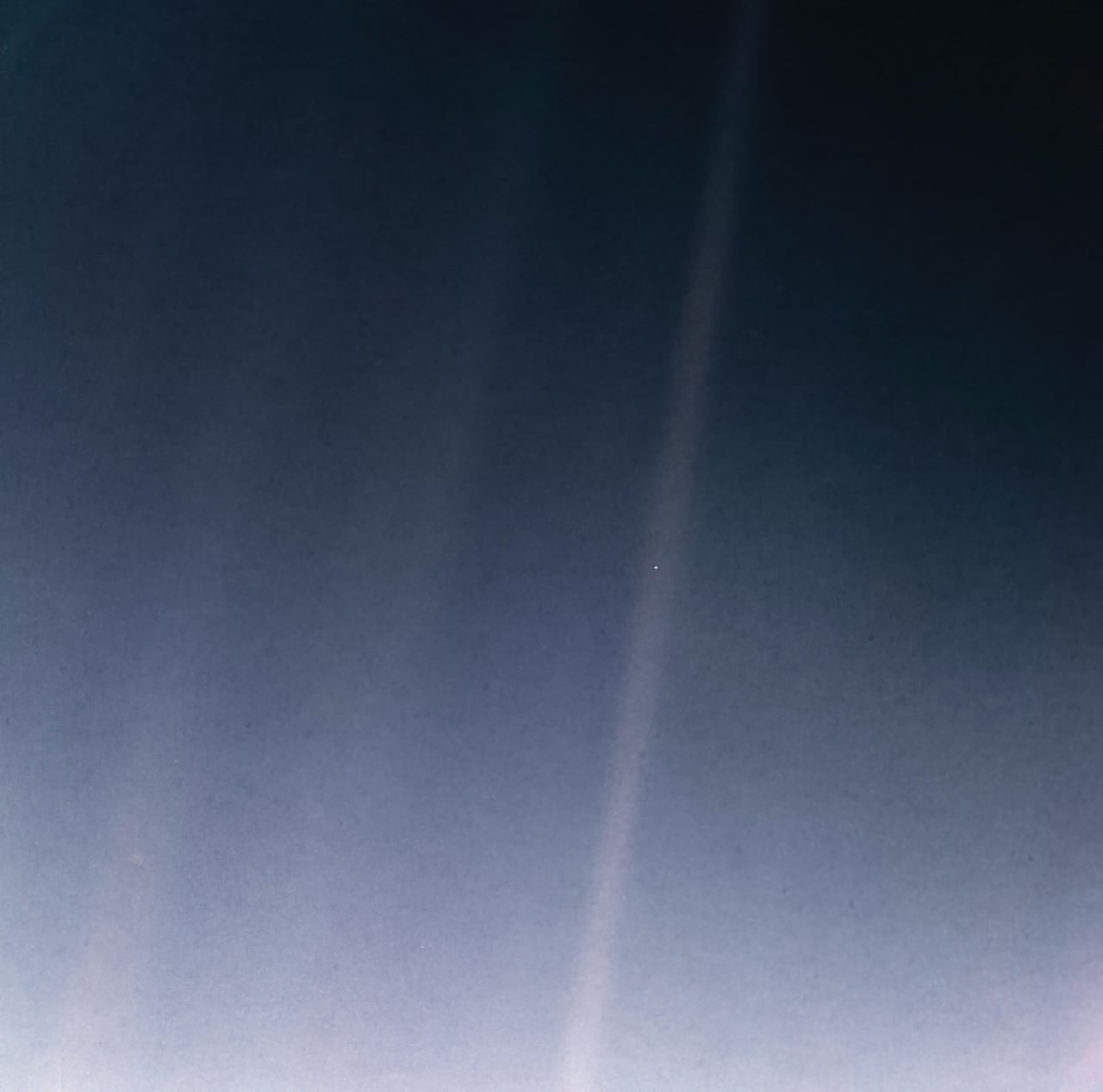
The Pale Blue Dot is a photograph of Earth taken Feb. 14, 1990, by NASA’s Voyager 1 at a distance of 3.7 billion miles (6 billion kilometers) from the Sun. (NASA/JPL-Caltech)
Referred to as the Pale Blue Dot, this image depicts Earth as a minute speck illuminated by a beam of light. Requested by American astronomer Carl Sagan, it underscored the significance of our smallness in the universe in his book of the same title.
“Reflect on that dot. That’s our home. That’s us.”