

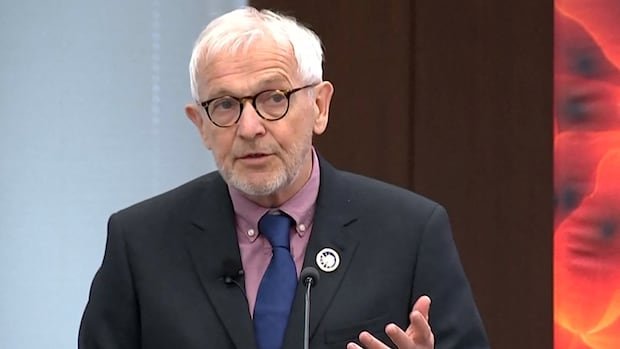

Belgian-American physicist Francis Halzen, at 82 years old, was named as the recipient of the 2026 Nobel Prize in Physics in Stockholm on Tuesday. The award committee acknowledged his significant contributions to the IceCube Neutrino Observatory and the identification of high-energy neutrinos from astrophysical sources. Situated at the Amundsen–Scott South Pole Station in Antarctica, Halzen recognized the potential of using ice at the South Pole to track neutrinos, often referred to as “ghost particles” due to their ability to traverse the Earth and human bodies without leaving a trace, interacting with matter only very rarely.
According to Eva Olsson from the Royal Swedish Academy of Sciences, these neutrinos act as messengers from the universe, providing insights into distant galaxies and the phenomena of exploding stars. Winners of the Nobel Prize in Physics are chosen annually by the Royal Swedish Academy of Sciences and are awarded a prize of 12 million Swedish crowns ($1.7 million Cdn).
The IceCube observatory, covering a full cubic kilometer, commenced operations in 2011, marking the realization of a concept dating back to the late 1980s. Halzen expressed gratitude to his collaborators over the years, highlighting the initial skepticism surrounding the project’s success.
Affiliated with the University of Wisconsin–Madison for several decades, Halzen conveyed his surprise and delight at the announcement of the Nobel Prize while attending a conference in Italy. In 2014, Halzen was dubbed “Neutrino Man” by the U.S.-based Smithsonian magazine when he received one of its Ingenuity Awards.
Neutrinos, minute cosmic particles with incredibly small mass, are ubiquitous and originate from stars like the sun, with trillions passing through our bodies every second. Scientists observe the impact of neutrino collisions with matter, generating light flashes or charged particles, as they cannot directly detect these ghostly entities.
Mark Pearce, head of the Nobel Committee for Physics, lauded Halzen for leading an international team that developed a groundbreaking instrument, opening new avenues for astronomy. Plans are underway for an extension to the observatory, IceCube-Gen2, which will cover eight cubic kilometers of ice and enhance neutrino detection capabilities.
Halzen stressed that the full implications of his work are yet to be unveiled, expressing excitement over the potential for future discoveries in astronomy. Belgian Prime Minister Bart De Wever commended Halzen for his dedication to unraveling cosmic mysteries through the study of neutrinos.
The Nobel Prize for Physics marks Halzen’s significant achievement, aligning with the legacy of Alfred Nobel, the Swedish inventor of dynamite whose estate funds prizes recognizing those who contribute most to humanity. The Nobel laureates will be honored on December 10, the anniversary of Nobel’s passing.