

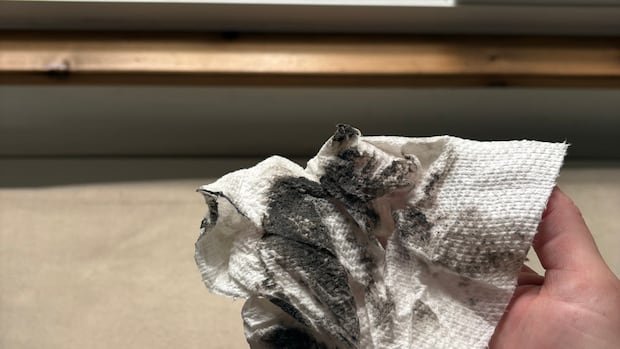

A group of researchers in Hamilton has provided insights into the issue of soot accumulation in neighborhoods near the city’s industrial hub. Over the years, residents have voiced concerns about a dark, dirty substance covering their properties. The problem resurfaced in early July, with residents experiencing what some described as the most severe fallout in recent memory.
Sarah Styler, an associate professor specializing in environmental chemistry at McMaster University, along with Grace Yao, a Ph.D. candidate in Styler’s research group, are involved in a study titled “What’s the Grime?” aimed at addressing this issue. By collaborating with volunteers to gather samples across the city in 2024 and 2025, the researchers discovered that the soot contains hazardous chemicals associated with coal combustion. Moreover, they observed elevated levels of dust and polycyclic aromatic hydrocarbons (PAHs) near the industrial zone in northeast Hamilton.
Styler collaborated with Environment Hamilton on this study, which was supported by a $15,000 grant awarded by the university in 2024. Having firsthand experience with the soot in east Hamilton, Styler emphasized the longstanding nature of the problem, mentioning that references to the soot date back to the 1950s in news archives.
The research involved collecting soot samples from the homes of 50 volunteers throughout the city using sampling kits. Scientists analyzed these samples at four-month intervals, revealing that more dust and toxic compounds were present closer to the industrial sector. An update shared by the team on the Environment Hamilton website highlighted that PAH levels were higher in the winter compared to the summer.
Although the study focused on 13 different PAHs, Styler mentioned that other toxic substances could also be present in the soot. While the study couldn’t explore all components of the grime due to resource constraints, it confirmed the significant contribution of coal combustion to the PAHs detected.
Styler’s team refrained from pinpointing specific industrial sources responsible for the PAHs but suggested that with enhanced monitoring and analytical capabilities, such identification could be possible. The findings of the study, according to Styler, are likely unsurprising to residents directly impacted by the fallout, as the origin of the substance affecting neighborhoods near coke plants is believed to be industrial emissions.
Despite the community’s frustration over the lack of official information, efforts are underway to determine the source of the soot. The Ministry of the Environment, Conservation and Parks in Hamilton’s north end is conducting tests to identify potential sources. Styler emphasized that their research aligns with the community’s claims that the soot is predominantly an industrial byproduct.
The researchers plan to present their findings at a community meeting on August 20, with further insights to be shared upon completion of the peer review process. They aim to expand the study to include 200 volunteers, explore additional compounds in the grime, and investigate effective cleaning methods.